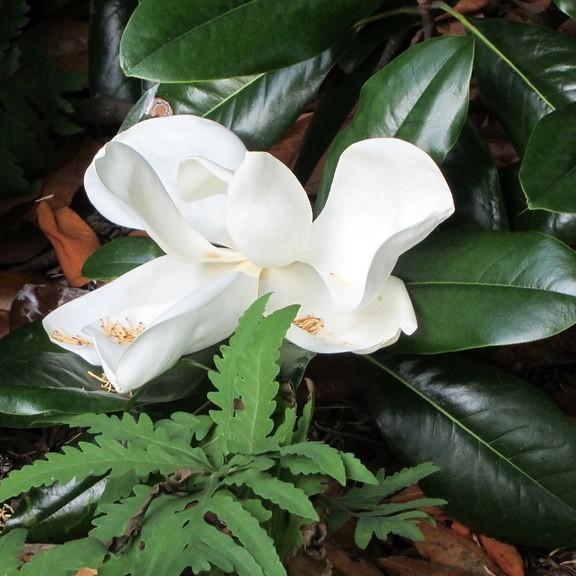
Large Flowered Magnolia
Magnolia grandiflora
Overview
The large flowered magnolia, also called southern magnolia, is a slow-growing evergreen tree iconic to the American Southeast. It bears large, cup-shaped white flowers up to 12 inches (30 cm) across that release a sweet, heady fragrance from late spring to early fall. Its thick, dark green leaves have rusty brown fuzzy undersides, and it produces cone-like red seed pods in autumn that attract songbirds.
Care Guide
Watering
Water young trees regularly for the first 2-3 years to establish a deep root system, keeping soil consistently moist but not waterlogged. Mature trees are moderately drought tolerant, but supplemental watering during prolonged dry spells supports healthy growth and bloom production. Avoid overwatering in heavy clay soils to prevent root rot.
Light
Thrives in full sun to partial shade, with at least 4 hours of direct sunlight daily for optimal flower production. In extremely hot, arid climates, light afternoon shade protects foliage from scorch. Too much deep shade reduces bloom density and leads to sparse, leggy growth.
Soil
Prefers moist, well-drained, acidic loam soils with a pH between 5.0 and 6.5, though it adapts to sandy, clay, or loamy soils as long as drainage is good. It is moderately tolerant of salt spray, making it suitable for coastal plantings. Alkaline soils cause iron deficiency, leading to yellowing foliage.
Fertilizer
Feed young trees in early spring with a slow-release, acid-forming fertilizer formulated for evergreens to support steady growth. Mature trees only require fertilization every 2-3 years, applied around the root zone and watered in thoroughly. Avoid fertilizing after mid-summer, as new growth may be damaged by early frost.
Temperature
Grows best in USDA hardiness zones 7 through 10, preferring average temperatures between 60-90°F (15-32°C) during the growing season. It can tolerate brief dips down to 10°F (-12°C) once established, but young trees need winter protection in the colder end of its range. Extreme heat above 100°F (38°C) may cause leaf burn without adequate moisture.
Pruning
Prune only to remove dead, damaged, or crossing branches in late winter before new growth emerges, as heavy pruning can reduce bloom production and leave the tree vulnerable to disease. Avoid pruning lower branches if a natural, rounded form is desired, as the tree naturally maintains a dense, pyramidal shape as it matures. Always use clean, sharp tools to make smooth cuts that heal quickly.
Propagation
Most commonly propagated via semi-hardwood cuttings taken in mid-summer, treated with rooting hormone, and kept in a humid, warm environment until roots form in 2-3 months. It can also be grown from seed, but seeds require 3-6 months of cold stratification to germinate, and seed-grown trees may take 10-15 years to produce flowers. Grafting onto hardy rootstock is used for named cultivars to ensure consistent flower characteristics.
Humidity
Adaptable to average humidity levels between 40-70%, which are typical of its native southeastern US habitat. It tolerates occasional dry air but thrives in more humid conditions common to subtropical and warm temperate regions. Indoor container specimens benefit from occasional misting in dry, heated indoor spaces.
Repotting
Container-grown specimens should be repotted every 2-3 years in early spring, moving to a pot 2-3 inches larger than the current one using a well-drained acidic potting mix. Mature container trees can be top-dressed with fresh potting mix annually instead of full repotting to reduce root disturbance. Ensure pots have ample drainage holes to prevent standing water around the root zone.
Uses & Symbolism
Widely planted as a specimen shade tree or landscape focal point in residential and public gardens, valued for its year-round evergreen foliage and dramatic fragrant blooms. Its dense growth habit makes it an effective privacy screen or windbreak when planted in rows. The cut flowers and foliage are popular in floral arrangements, and the wood is occasionally used for furniture and crafts.
Diseases & Pests
Common fungal issues include leaf spot, anthracnose, and verticillium wilt, which can be prevented by ensuring good air circulation around the tree and avoiding overhead watering. Pests such as scale insects, magnolia weevils, and spider mites may infest stressed trees, and can be controlled with horticultural oil or appropriate insecticides. Root rot occurs in poorly drained, waterlogged soils, which can be fatal to young and mature trees alike.
Related plants
Other plants you might like if you grow Large Flowered Magnolia.