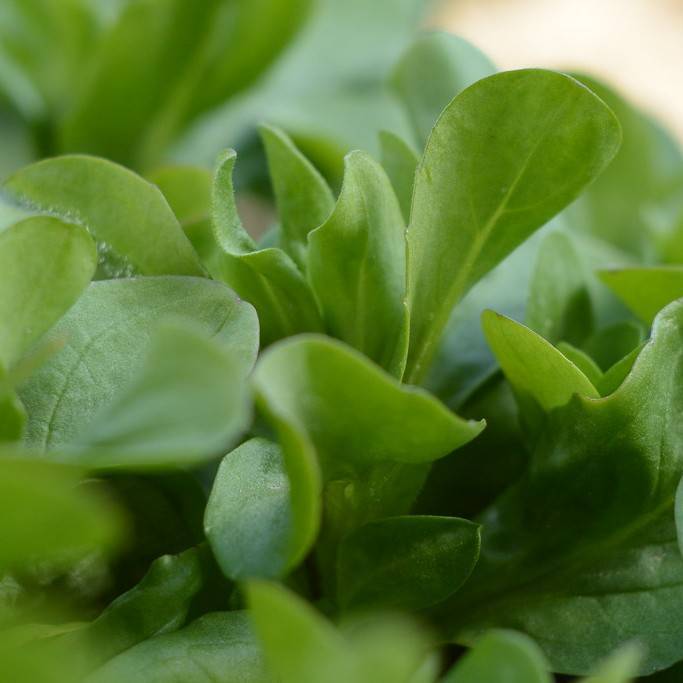
Lamb's Lettuce
Valerianella locusta
Overview
Lamb's lettuce, also called corn salad or mâche, is a small, low-growing annual green prized for its mild, slightly sweet flavor and soft, rounded leaves. It naturally grows as a winter weed in grain fields across its native range, and has been cultivated for culinary use since at least the 17th century. It is highly cold-hardy, surviving light frosts and temperatures as low as 20°F (-7°C), making it a popular crop for fall and winter harvests in temperate regions.
Care Guide
Watering
Keep soil consistently moist but not waterlogged, providing approximately 1 inch of water per week. Avoid overhead watering to reduce the risk of foliar diseases, and water early in the day to let leaf surfaces dry quickly. Reduce watering frequency during extended cold or rainy periods to prevent root rot.
Light
Grows best in full sun to partial shade, with partial shade preferred in warmer climates to prevent bolting and leaf bitterness. In cool fall and winter conditions, full sun exposure supports steady, healthy leaf growth. Avoid planting in full, intense summer sun, as this will cause the plant to go to seed rapidly.
Soil
Prefers well-draining, loamy or sandy soil with a neutral to slightly alkaline pH between 6.5 and 7.5. It tolerates poorer, less fertile soils better than many other leafy greens, but will produce more tender foliage in soil amended with compost or well-rotted organic matter. Avoid heavy, compacted soils that hold excess moisture around the shallow root system.
Fertilizer
Light fertilization is sufficient for lamb's lettuce, as excess nitrogen can lead to soft, floppy growth and reduced flavor. Incorporate a balanced, slow-release organic fertilizer into the soil at planting time, and no additional feeding is required for the short growing season. If grown in extremely poor soil, a diluted liquid organic feed can be applied once 3-4 weeks after germination.
Temperature
Thrives in cool temperatures between 40°F and 65°F (4°C and 18°C), and can survive short dips down to 20°F (-7°C) with minimal damage. Temperatures above 70°F (21°C) trigger rapid bolting, making the leaves bitter and unpalatable. It is ideally planted in early spring 2-4 weeks before the last frost, or in late summer for fall and winter harvest.
Pruning
No formal pruning is required for lamb's lettuce, which is harvested by cutting outer leaves 1 inch above the soil line to allow regrowth of new foliage. Remove any yellowed or damaged leaves regularly to improve air circulation and prevent fungal issues. Once the plant begins to send up a flower stalk, pull the entire plant, as the leaves will become bitter at this stage.
Propagation
Propagated exclusively from seed, sown directly in the garden as it does not transplant well due to its shallow, delicate root system. Sow seeds ¼ inch deep, spacing rows 6 inches apart, and thin seedlings to 3 inches apart once they develop their first true leaves. Successive sowing every 2-3 weeks in cool weather provides a continuous harvest.
Humidity
Tolerates a wide range of humidity levels, but prefers moderate humidity between 40% and 70% for optimal growth. High humidity combined with poor air circulation can increase the risk of downy mildew and other foliar fungal diseases. Very low humidity, common in heated indoor spaces, can cause leaf edges to crisp if grown as a winter indoor crop.
Repotting
Repotting is rarely needed for lamb's lettuce, as it is almost always grown directly in garden beds or outdoor containers for its full short lifecycle. If started in small seedling pots, transplant very carefully when seedlings have 2-3 true leaves to avoid disturbing the root system, and handle only by the leaves to prevent stem damage. Container-grown plants do not need repotting during their growing season, as their root system stays small and shallow.
Uses & Symbolism
Lamb's lettuce is primarily used as a fresh salad green, often mixed with other greens to add a mild, nutty flavor and soft texture; it pairs well with vinaigrettes, nuts, cheese, and citrus. It is highly nutritious, containing high levels of vitamin C, iron, beta-carotene, and omega-3 fatty acids, making it a nutrient-dense addition to raw dishes. In some regions, it is also lightly cooked like spinach and added to soups, stir fries, or side dishes, though it loses some of its delicate texture when heated.
Diseases & Pests
Lamb's lettuce is relatively pest and disease resistant, particularly when grown in cool, well-spaced conditions. The most common diseases are downy mildew and powdery mildew, which occur in high humidity with poor air circulation, and can be prevented by avoiding overhead watering and providing adequate spacing between plants. Common pests include aphids and flea beetles, which can be controlled with insecticidal soap, row covers, or companion planting with strongly scented herbs like mint or garlic.
Related plants
Other plants you might like if you grow Lamb's Lettuce.