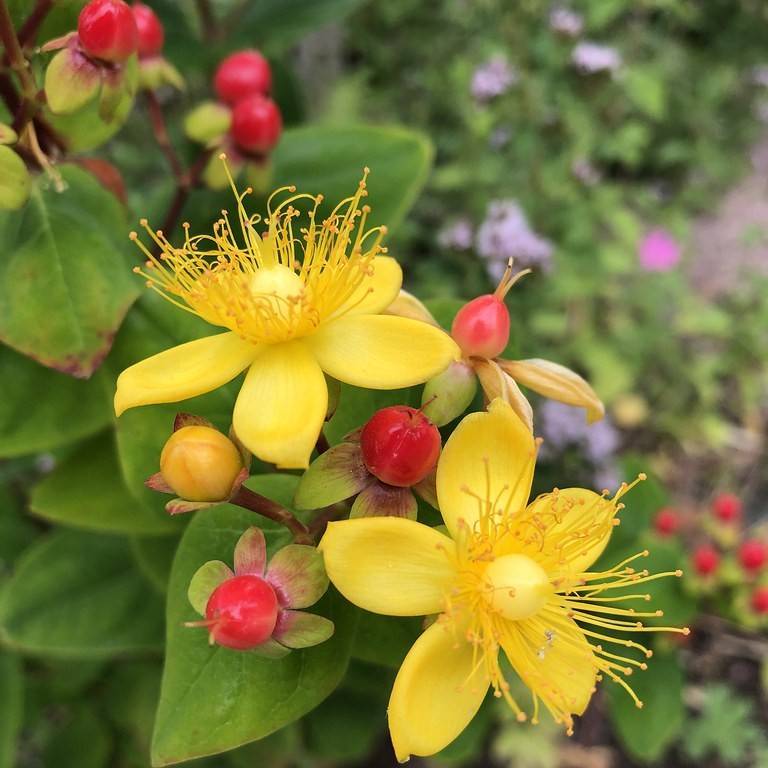
St. John's Wort
Hypericum perforatum
Overview
Hypericum, commonly called St. John's Wort, is a clump-forming perennial distinguished by opposite, oblong leaves dotted with tiny translucent glands, and cheery five-petaled yellow flowers that bloom in mid to late summer. The plant gets its common name from its traditional bloom time around the feast of St. John the Baptist in late June, and its perforatum epithet refers to the tiny holes visible in leaves when held up to light. It has a long history of use in traditional herbal medicine, most commonly as a topical treatment for wounds and a oral remedy for mild to moderate depression. While it is often grown as an ornamental for its bright blooms, it can become invasive in some regions due to its aggressive rhizomatous spread and self-seeding habit.
Care Guide
Watering
Water newly planted hypericum regularly to keep the soil evenly moist for the first growing season, until the root system is fully established. Mature plants are highly drought tolerant, requiring only occasional watering during extended periods of hot, dry weather, and are susceptible to root rot if kept in consistently waterlogged soil. Reduce watering frequency in fall and winter, allowing the top 2 to 3 inches of soil to dry out completely between waterings during dormant periods.
Light
Hypericum thrives in full sun, which encourages the heaviest bloom production and sturdiest, most compact growth habit. It can tolerate partial shade, though plants grown in shadier conditions will produce fewer flowers and may develop lanky, sprawling growth that requires staking. In regions with extreme midday summer heat, provide light afternoon shade to prevent leaf scorch and reduce moisture stress.
Soil
This adaptable plant grows well in a wide range of soil types, including sandy, loamy, and even poor, rocky soils, as long as the site has excellent drainage. It prefers a neutral to slightly alkaline soil pH between 6.0 and 8.0, though it can tolerate mildly acidic conditions as well. Heavy clay soils should be amended with coarse sand, compost, or gravel to improve drainage before planting, as standing water will quickly cause root rot and plant death.
Fertilizer
Hypericum has low nutrient needs and rarely requires regular fertilization, especially when grown in average garden soil. Over-fertilization will lead to excessive, soft foliage growth at the expense of flower production and can make the plant more susceptible to pest infestations. If growth is particularly stunted, apply a balanced, slow-release 10-10-10 fertilizer once in early spring at half the recommended label rate, avoiding contact with the plant's crown and stems.
Temperature
Hypericum is cold hardy in USDA zones 3 through 9, tolerating winter temperatures as low as -40°F (-40°C) once established. It prefers average summer temperatures between 60°F and 80°F (15°C to 27°C), though it can tolerate short periods of heat above 90°F (32°C) if provided with adequate moisture. In regions with harsh winters, apply a 2 to 3 inch layer of mulch around the base of the plant in late fall to insulate the root system from extreme temperature fluctuations.
Pruning
Prune hypericum back hard to 2 to 4 inches above the soil line in late winter or early spring before new growth emerges, which encourages fresh, bushy growth and abundant flowering for the coming season. Deadhead spent blooms regularly throughout the summer to extend the flowering period and prevent the plant from self-seeding aggressively in garden beds. If plants become lanky or overgrown mid-season, shear them back by one-third to one-half their height to promote a tidier, more compact form.
Propagation
Hypericum is most easily propagated by division in early spring or late fall, when the plant is dormant; dig up established clumps, split them into smaller sections with healthy roots and at least one growth bud, and replant immediately at the same depth as the original plant. It can also be grown from seed sown directly in the garden in fall or started indoors 6 to 8 weeks before the last expected frost date, with germination occurring in 14 to 21 days under warm, bright conditions. Softwood cuttings taken from new growth in late spring or early summer root readily when placed in moist, well-draining potting mix and kept under high humidity for 3 to 4 weeks.
Humidity
Hypericum adapts well to a wide range of humidity levels, thriving in the average ambient humidity of most temperate garden environments, between 40% and 60%. It tolerates low humidity conditions common in arid regions well, as long as it receives adequate moisture at the root zone. High humidity combined with poor air circulation can increase the risk of fungal leaf spot and powdery mildew, so space plants 2 to 3 feet apart to allow for good air flow around foliage.
Repotting
Hypericum grown in containers should be repotted every 2 to 3 years in early spring, before new growth begins, to refresh the potting medium and provide extra room for root expansion. Choose a container with drainage holes that is 1 to 2 inches larger in diameter than the current pot, and use a well-draining potting mix amended with perlite or coarse sand to improve drainage. After repotting, water thoroughly and place the plant in a partially shaded location for 1 to 2 weeks to allow it to acclimate to its new container before moving it back to full sun.
Uses & Symbolism
Hypericum is widely cultivated as an ornamental plant for borders, rock gardens, and naturalized meadows, where its bright yellow flowers provide long-lasting summer color and attract pollinators including bees and butterflies. It has a long history of medicinal use, with extracts of the leaves and flowers commonly used in herbal remedies for mild to moderate depression, anxiety, and topical treatment for minor wounds, burns, and nerve pain. Some hypericum species are also grown for their decorative red or purple berries, which are popular additions to cut flower arrangements.
Diseases & Pests
Hypericum is relatively resistant to most pests and diseases, though it can be susceptible to fungal issues including powdery mildew, leaf spot, and rust, especially in conditions of high humidity and poor air circulation. Common pest infestations include aphids, scale insects, and spider mites, which typically target new growth and can be controlled with insecticidal soap or neem oil applications. Root rot is a major issue in poorly draining soils, and can be prevented by planting in well-drained sites and avoiding overwatering.
Related plants
Other plants you might like if you grow St. John's Wort.