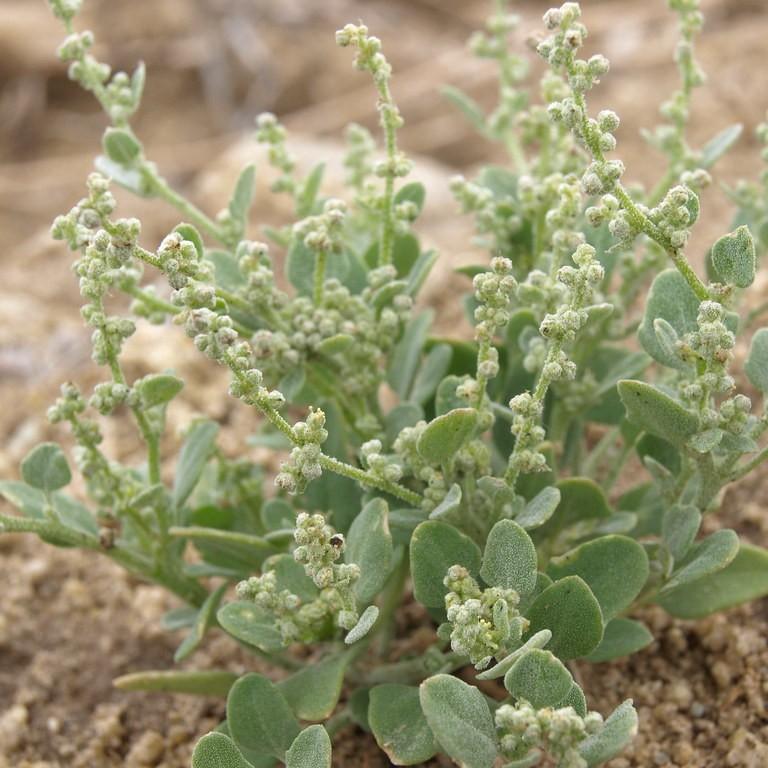
Hoary Goosefoot
Chenopodium incanum
Overview
Hoary goosefoot gets its common name from the dense, silvery-white hairs that coat its triangular, toothed leaves, giving the plant a frosted, or hoary, appearance. It thrives in dry, open sites, including roadsides, rangelands, and rocky slopes, often acting as a pioneer species in disturbed or eroded soils. From mid-summer to early fall, it produces dense spikes of tiny, inconspicuous green flowers that mature into small, nutrient-dense seeds. This hardy species is well-adapted to low-moisture environments, requiring little intervention to establish and spread in suitable climates.
Care Guide
Watering
Hoary goosefoot is extremely drought-tolerant, requiring only occasional rainfall in its native range; supplemental watering is rarely needed once established, and overwatering can cause root rot or leggy growth. In garden settings, water only during extended periods of no rainfall, allowing the soil to dry out completely between waterings. Avoid wetting the foliage when watering to reduce the risk of fungal growth on the plant’s fuzzy leaves.
Light
This species requires full, direct sunlight for at least 6 hours per day to thrive, as shaded conditions will lead to sparse foliage and reduced seed production. It can tolerate intense, unfiltered desert sun and high UV exposure without leaf scorch, making it ideal for open, unshaded garden beds or xeriscape plantings. It will not perform well in partial or full shade, where it may become weak and susceptible to pest infestations.
Soil
Hoary goosefoot adapts to a wide range of soil types, including sandy, loamy, gravelly, and even poor, nutrient-depleted soils, as long as drainage is excellent. It tolerates slightly alkaline to neutral pH levels, and is even adapted to grow in moderately saline soils common in arid western regions. Heavy, waterlogged clay soils will kill the plant quickly, so amend heavy garden soils with sand or gravel to improve drainage before planting.
Fertilizer
This species does not require fertilization, as it is adapted to low-nutrient soils; excess nitrogen will promote excessive leaf growth at the expense of seed production and reduce the plant’s drought tolerance. If grown in extremely poor, sterile soil, a single light application of a balanced, slow-release fertilizer in early spring can support initial growth, but this is rarely necessary. Avoid using high-nitrogen liquid fertilizers, as they can cause the plant to become leggy and prone to flopping.
Temperature
Hoary goosefoot thrives in warm to hot summer temperatures, tolerating highs above 100°F (38°C) with no adverse effects, and can withstand light, short-duration frosts in early fall. It is adapted to USDA hardiness zones 4 through 10, and will complete its full life cycle in a single growing season even in regions with short, cool summers. Germination occurs once soil temperatures consistently reach 60°F (15°C) in late spring, and the plant will die back completely after the first hard frost of autumn.
Pruning
Pruning is generally unnecessary for hoary goosefoot, though you can trim back leggy stems in early summer to encourage a bushier, more compact growth habit. If you wish to prevent self-seeding, cut back the flower spikes before they mature and release seeds in late fall, as the plant can spread aggressively in ideal growing conditions. Remove any dead or diseased foliage as needed to improve air circulation around the base of the plant.
Propagation
Hoary goosefoot is easily propagated from seed, which can be sown directly outdoors in late spring after all risk of frost has passed, with no stratification required for germination. Scatter seeds lightly on the surface of bare, well-drained soil, and press them gently into the surface, as they require light to germinate; keep the soil slightly moist until seedlings emerge, which typically takes 7 to 14 days. The plant will self-seed readily in garden settings, producing new volunteer seedlings each spring if seed heads are left to mature.
Humidity
This species prefers low to moderate humidity levels, and is well-adapted to the dry air of desert and semi-arid regions, where relative humidity often drops below 30% during the summer months. High humidity, especially combined with warm temperatures and poor air circulation, can lead to fungal leaf spots and powdery mildew on the plant’s fuzzy foliage. In regions with high summer humidity, space plants at least 12 inches apart to promote air flow and reduce moisture retention on leaf surfaces.
Repotting
Hoary goosefoot is rarely grown in containers, as it prefers to spread its roots in open soil, but if potted, use a fast-draining cactus or succulent potting mix and a container with ample drainage holes. It will not need repotting during its single growing season, as it completes its life cycle in one year and dies back after frost. If growing from seed in containers, thin seedlings to one per 6-inch pot once they develop their second set of true leaves to avoid overcrowding.
Uses & Symbolism
Hoary goosefoot has a long history of use as a food source by Indigenous peoples of North America, who harvest its nutrient-dense seeds to grind into flour or cook as a grain, and its young leaves as a cooked green similar to spinach. It is also valued in xeriscape and native plant gardens for its drought tolerance, silvery foliage contrast, and ability to support native pollinators and seed-eating birds, including finches and sparrows, that feed on its abundant seed heads. It is occasionally used for erosion control on disturbed or degraded arid sites, as its fast root system stabilizes soil and prevents runoff.
Diseases & Pests
Hoary goosefoot is relatively pest and disease resistant, though it can be susceptible to fungal leaf spots and powdery mildew in high humidity or overly wet conditions, which can be prevented by ensuring proper air circulation and avoiding overwatering. Aphids and leaf miners may occasionally feed on the foliage, though infestations are rarely severe and can be treated with a strong spray of water or insecticidal soap if needed. It may also be affected by root rot if grown in poorly drained, waterlogged soil, which can be avoided by amending heavy soils to improve drainage before planting.
Related plants
Other plants you might like if you grow Hoary Goosefoot.