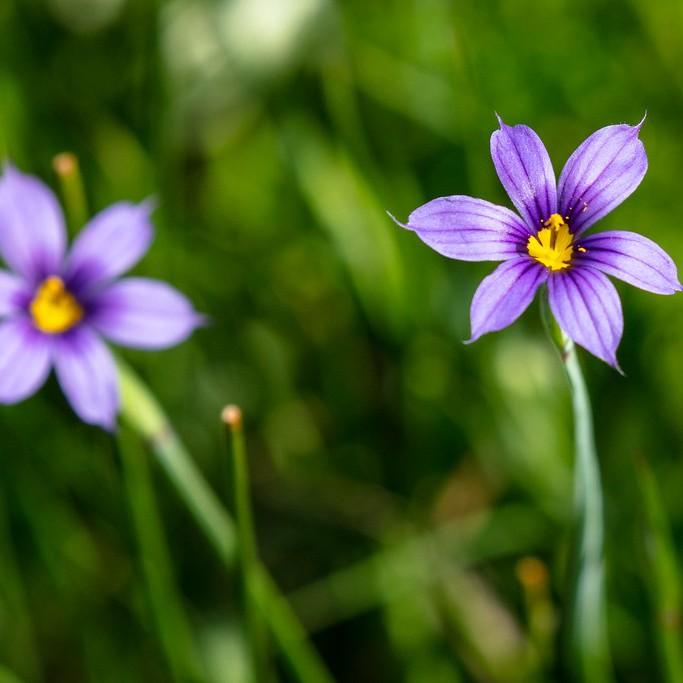
Blue Eyed Grass
Sisyrinchium campestre
Overview
Blue Eyed Grass is a clumping herbaceous perennial, often mistaken for a true grass due to its narrow, linear foliage, but it is a member of the iris family. Its dainty, six-petaled blue flowers with bright yellow centers bloom atop thin, upright stems, opening in full sun and closing during overcast conditions or in the evening. It spreads slowly via short rhizomes and self-seeds gently, forming dense, attractive groundcover in meadows, rock gardens, or native plant landscapes without becoming invasive.
Care Guide
Watering
Blue Eyed Grass prefers consistently moist, well-drained soil during its active growth and blooming period, though it tolerates short periods of drought once established. Avoid overwatering or allowing the plant to sit in standing water, as this can cause rhizome rot, particularly in winter. Water deeply once per week during dry spells, reducing frequency in fall and winter when the plant is dormant.
Light
This species thrives in full sun, requiring a minimum of six hours of direct sunlight daily to produce abundant blooms. It can tolerate light partial shade, especially in hot southern climates, though flowering will be reduced and the plant may become leggier in lower light conditions. Avoid dense, full shade, as it will severely limit blooming and may cause the clumps to die back prematurely.
Soil
Blue Eyed Grass adapts to a wide range of soil types, including sandy, loam, and clay soils, as long as they drain well. It prefers a neutral to slightly alkaline soil pH between 6.0 and 7.5, though it can tolerate mildly acidic conditions. It does not thrive in heavy, waterlogged soils, so amending dense clay with compost or sand will improve drainage and support healthier growth.
Fertilizer
This native plant is adapted to low-nutrient soils and generally does not require regular fertilization. A light application of balanced, slow-release granular fertilizer in early spring can support growth if planted in very poor, sandy soil, but over-fertilization will lead to excessive foliage growth and reduced flowering. Avoid high-nitrogen fertilizers, as they will prioritize leaf production over bloom formation.
Temperature
Blue Eyed Grass is cold-hardy in USDA zones 3 through 8, tolerating winter temperatures as low as -40°F (-40°C). It thrives in average summer temperatures between 60°F and 85°F (15°C to 29°C), and will go dormant and die back to the ground in late fall once temperatures drop consistently below freezing. In very hot, arid climates, it may benefit from light afternoon shade to prevent foliage scorch.
Pruning
Pruning is minimal for Blue Eyed Grass; spent flower stems can be deadheaded after blooming to prevent unwanted self-seeding, if desired. In late fall or early spring, cut back the dead, brown foliage to the ground to make space for new spring growth and reduce the risk of fungal diseases overwintering in old plant material. Avoid pruning green, actively growing foliage, as this will reduce the plant’s ability to photosynthesize and store energy for the next growing season.
Propagation
Blue Eyed Grass is most easily propagated by dividing mature clumps in early spring before new growth emerges, or in fall after blooming has finished. Dig up the entire clump, gently separate the rhizomes into smaller sections with at least 3-5 healthy shoots each, and replant immediately at the same depth they were originally growing. It can also be grown from seed sown directly outdoors in fall, as the seeds require a period of cold stratification to germinate, with seedlings blooming in their second year of growth.
Humidity
This species tolerates a wide range of humidity levels, thriving in the average 40-70% relative humidity common across its native North American range. It does not require extra humidity, even in dry indoor growing conditions, though it may experience mild leaf tip browning in extremely arid, low-humidity environments. Good air circulation around the foliage helps prevent fungal leaf spot diseases in high-humidity regions.
Repotting
When grown in containers, Blue Eyed Grass should be repotted every 2-3 years in early spring, or when the clump becomes root-bound and outgrows its pot. Choose a pot with drainage holes, and use a well-draining potting mix amended with a small amount of compost to provide mild nutrients. When repotting, you can divide the clump into smaller sections to create new plants, or move the entire clump to a larger pot to accommodate continued growth.
Uses & Symbolism
Blue Eyed Grass is a popular choice for native pollinator gardens, as its blooms provide nectar for small bees, syrphid flies, and native butterflies. It works well as a low edging plant for walkways, a filler in rock gardens, or a groundcover in meadow or prairie plantings, where its delicate blooms add subtle, long-lasting color in late spring and early summer. Historically, some Indigenous North American tribes used the plant medicinally to treat stomach issues and as a wash for eye irritations, though it is not commonly used for these purposes today.
Diseases & Pests
Blue Eyed Grass is largely pest and disease resistant, though it can develop fungal leaf spot or root rot in poorly drained, waterlogged soils. Aphids and spider mites may occasionally infest the foliage, particularly in dry, hot conditions, but can be controlled with a strong spray of water or insecticidal soap. Slugs and snails may feed on young, tender foliage in damp, shaded locations, so use copper barriers or organic slug bait to protect new growth if damage is observed.
Related plants
Other plants you might like if you grow Blue Eyed Grass.