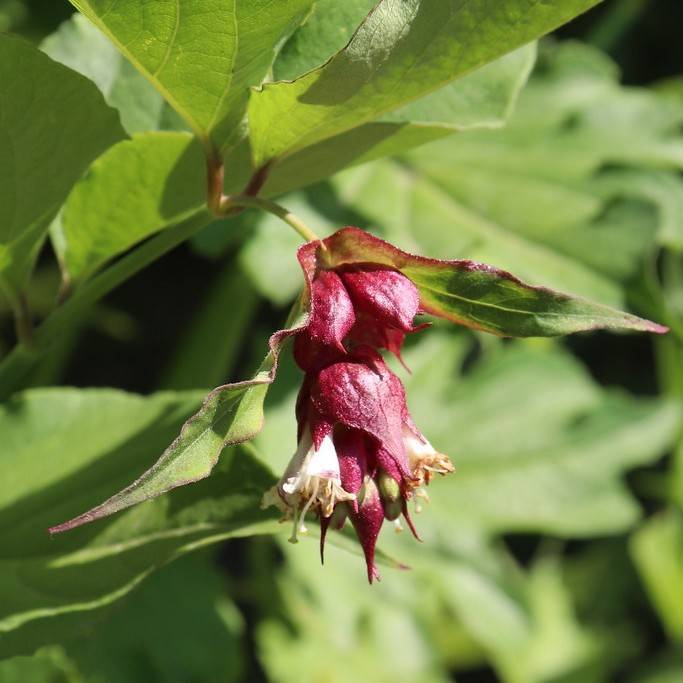
Himalayan Honeysuckle
Leycesteria formosa
Overview
Himalayan honeysuckle, also called pheasant berry or flowering nutmeg, is a fast-growing deciduous shrub prized for its unusual drooping inflorescences of creamy white flowers framed by showy deep purple-red bracts. It blooms from mid-summer to early autumn, followed by clusters of glossy, dark purple berries that are a favored food source for birds and small mammals. Though native to high-elevation Asian habitats, it has naturalized in parts of Europe, North America, and Oceania, and is classified as invasive in some mild, wet regions due to its self-seeding habit.
Care Guide
Watering
Water young Himalayan honeysuckle regularly to keep the soil consistently moist but not waterlogged for the first two growing seasons, until the root system is fully established. Mature plants are moderately drought tolerant, only requiring supplemental watering during prolonged dry spells to prevent leaf drop. Avoid overwatering in heavy, poorly drained soils, as this can lead to root rot.
Light
This shrub thrives in partial shade, producing the most vibrant bract color and abundant blooms when given dappled sunlight or 3-6 hours of direct morning sun with afternoon shade. It can tolerate full sun in cooler climates, but will require more frequent watering to prevent foliage scorch. In deep full shade, growth will be leggy and flowering will be significantly reduced.
Soil
Himalayan honeysuckle adapts to a wide range of soil types, including sandy, loam, and clay soils, as long as they drain well. It prefers a neutral to slightly acidic pH between 6.0 and 7.5, but will tolerate mildly alkaline conditions with no adverse effects. Amending poor soils with organic matter like well-rotted compost at planting time will support faster, healthier growth.
Fertilizer
This shrub is a light feeder, requiring only one annual application of balanced, slow-release granular fertilizer (10-10-10) in early spring just before new growth emerges. Over-fertilizing will lead to excessive, floppy foliage growth at the expense of flowers and berries, so avoid applying fertilizer more than once per year. For plants grown in very poor, sandy soils, a light topdressing of compost in mid-summer can provide extra nutrients without overfeeding.
Temperature
It is hardy to USDA zones 7-9, tolerating winter temperatures as low as 0°F (-18°C) once established. In colder zones, it can be grown as a herbaceous perennial, as top growth will die back to the ground in winter and regrow from the root system in spring. It prefers cool summer temperatures and may suffer from leaf scorch if exposed to extended periods of heat above 90°F (32°C) without shade.
Pruning
Prune Himalayan honeysuckle in late winter or early spring before new growth begins to maintain a tidy shape and encourage vigorous flowering stems. Remove any dead, damaged, or crossing branches, and cut back up to one-third of the oldest stems to the ground to promote fresh, productive growth. In regions where it dies back to the ground in winter, cut all stems to 4-6 inches above the soil line in late winter to make way for new spring growth.
Propagation
The easiest method of propagation is by softwood cuttings taken in early summer, rooted in moist potting mix under indirect light, which typically root within 4-6 weeks. It can also be propagated from seed collected from ripe berries in autumn, sown directly outdoors in fall or cold-stratified for 3 months before sowing indoors in spring. Note that plants grown from seed may take 2-3 years to reach flowering maturity, while cuttings often bloom in their second year.
Humidity
Himalayan honeysuckle adapts well to average ambient humidity levels between 40-60%, which is typical of its native high-elevation habitat. It tolerates lower humidity levels as long as soil moisture is adequate, but may develop brown leaf edges in extremely dry, arid conditions. It does not require extra humidity, even when grown in containers indoors or in heated spaces over winter.
Repotting
If grown in containers, repot Himalayan honeysuckle every 2-3 years in early spring, moving it to a pot one size larger with fresh, well-draining potting mix amended with compost. Choose a heavy pot with drainage holes to prevent the top-heavy shrub from tipping over as it grows. Once the plant reaches its desired mature size, you can keep it in the same pot by root pruning annually, trimming back 1-2 inches of the outer root ball before replacing with fresh soil.
Uses & Symbolism
Himalayan honeysuckle is widely planted in wildlife gardens as a nectar source for pollinators like bumblebees and hummingbirds, and its berries provide food for pheasants, songbirds, and other small wildlife. It is often used as a decorative screen or border shrub in shaded garden areas where many flowering shrubs fail to thrive, thanks to its attractive bracts, arching growth habit, and vibrant autumn foliage. In its native range, the hollow stems are traditionally used to make flutes and pipes, while the ripe berries are occasionally eaten raw or made into jams when fully ripe, as unripe fruit has a bitter taste.
Diseases & Pests
Himalayan honeysuckle is largely pest and disease resistant, with only occasional infestations of aphids on new growth, which can be controlled with a strong jet of water or insecticidal soap. It is susceptible to root rot if planted in poorly drained, waterlogged soils, which presents as yellowing leaves, wilting, and stunted growth. In very humid, stagnant conditions, it may develop powdery mildew on foliage, which can be prevented by ensuring proper air circulation around the plant and avoiding overhead watering.
Related plants
Other plants you might like if you grow Himalayan Honeysuckle.