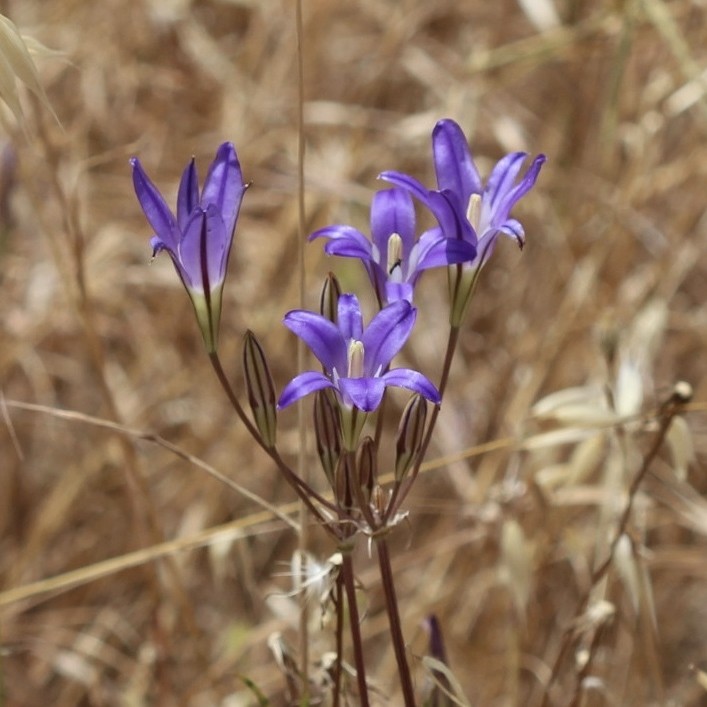
Harvest Brodiaea
Brodiaea elegans
Overview
Harvest Brodiaea, also called elegant brodiaea, is a hardy geophyte that dies back to an underground bulb after its blooming season. Its showy, violet-purple flowers grow in rounded umbels atop slender, leafless stalks, attracting native pollinators including bumblebees and butterflies. Drought-tolerant and low-maintenance, it is a popular choice for water-wise gardens, native plant landscapes, and naturalized meadow plantings.
Care Guide
Watering
Water regularly during active growth in spring, keeping soil evenly moist but not waterlogged to prevent bulb rot. Reduce watering gradually once blooms fade and foliage begins to yellow, and keep soil completely dry during the dormant summer and winter months.
Light
Thrives in full sun, requiring at least 6 hours of direct sunlight daily to produce abundant blooms. It can tolerate very light partial shade, but too much shade will result in leggy growth and reduced flowering.
Soil
Prefers well-drained, sandy or loamy soil with a neutral to slightly acidic pH. Heavy clay soils that hold moisture are unsuitable, as they will cause the bulb to rot during dormancy; amend heavy soils with sand or gravel to improve drainage before planting.
Fertilizer
Apply a low-nitrogen, bulb-specific fertilizer in early spring just as new growth emerges, to support healthy foliage and bloom development. Avoid high-nitrogen fertilizers, as they encourage excess leaf growth at the expense of flowers; no additional fertilization is needed during dormancy.
Temperature
Adaptable to USDA hardiness zones 5 to 9, tolerating winter lows down to -20°F (-29°C) when bulbs are planted at the appropriate depth of 3 to 4 inches. It requires a cool, dormant period in winter to trigger spring growth, and performs best in regions with dry, warm summers.
Pruning
Remove spent flower stalks after blooming if desired for a tidier appearance, but leave the foliage intact until it yellows and dies back naturally, as the leaves photosynthesize to store energy in the bulb for the next year’s growth. No regular pruning is required otherwise, and dead foliage can be gently pulled away once it is fully withered.
Propagation
Most easily propagated by dividing mature bulb offsets in late summer or early fall, during the plant’s dormant period. It can also be grown from seed, though seed-grown plants typically take 2 to 3 years to reach flowering maturity.
Humidity
Tolerates a wide range of humidity levels, and is well-adapted to the dry summer conditions of its native western North American range. High humidity during dormancy increases the risk of bulb rot, so ensure soil is kept dry during this period if grown in humid climates.
Repotting
If grown in containers, repot every 2 to 3 years during dormancy, separating overcrowded offsets to prevent reduced blooming. Use a well-draining potting mix formulated for bulbs or cacti, and ensure the container has ample drainage holes to prevent standing water.
Uses & Symbolism
Harvest Brodiaea is widely used in native plant gardens, drought-tolerant landscapes, and meadow naturalization projects to support local pollinator populations. Its long-lasting cut flowers are popular in floral arrangements, adding delicate purple color to bouquets. Historically, Indigenous peoples of the Pacific Northwest roasted and ate the starchy bulbs as a food source.
Diseases & Pests
Overly wet soil is the primary cause of issues, leading to bulb rot caused by fungal pathogens such as Fusarium and Pythium. Aphids and thrips may occasionally feed on young foliage and flower buds, which can be controlled with insecticidal soap or a strong blast of water. Slugs and snails may damage new spring growth in damp conditions, so use organic bait or barriers to protect young plants.
Related plants
Other plants you might like if you grow Harvest Brodiaea.