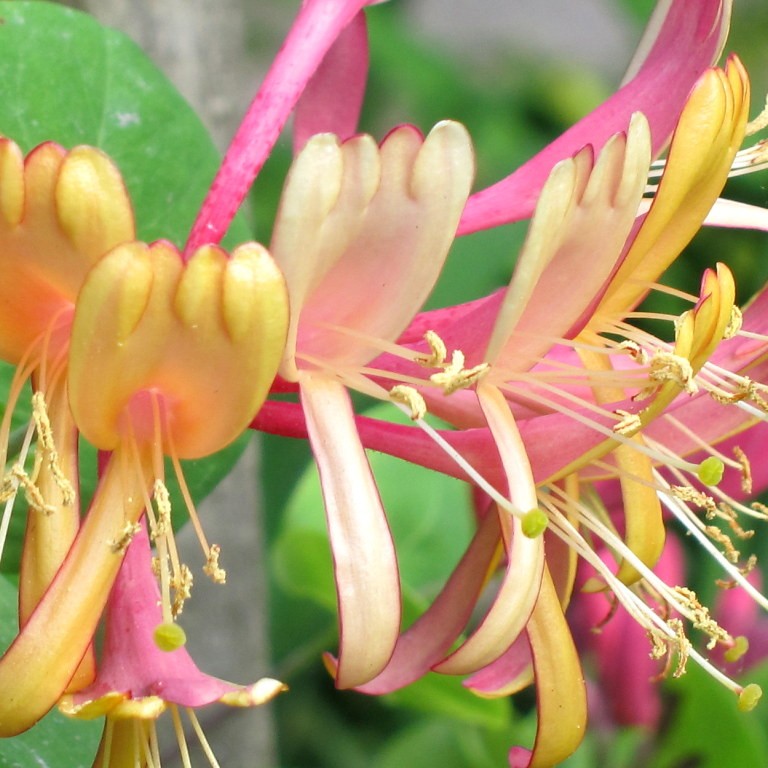
Goldflame Honeysuckle
Lonicera × heckrottii 'Goldflame'
Overview
Goldflame Honeysuckle is a popular ornamental hybrid vine prized for its vibrant, long-blooming flower clusters that emerge deep pink and open to reveal golden-yellow interiors, releasing a sweet, heady fragrance most intense in the evening. It is a vigorous but non-invasive cultivar, unlike some wild honeysuckle species, that climbs by twining around supports or forms a dense mounding shrub if left untrellised. It is deciduous in cooler climates but retains semi-evergreen foliage in mild, frost-free regions, with oval blue-green leaves that provide year-round visual interest.
Care Guide
Watering
Water newly planted Goldflame Honeysuckle regularly to keep the soil evenly moist but not waterlogged for the first growing season to establish a deep root system. Once established, it is moderately drought tolerant, requiring supplemental water only during extended dry periods, as overwatering can cause root rot. Avoid wetting the foliage when watering to reduce the risk of fungal diseases.
Light
Grow in full sun to partial shade, with at least 6 hours of direct sunlight daily for the most abundant and vibrant blooms. Too much shade will reduce flowering, cause sparse foliage, and make the vine more susceptible to pest infestations. In regions with extremely hot summer sun, light afternoon shade can prevent leaf scorch without impacting bloom production.
Soil
Adaptable to a wide range of well-drained soil types, including loam, sandy, and clay soils, with a preferred slightly acidic to neutral pH between 6.0 and 7.0. It tolerates poor soil fertility but will grow and bloom more vigorously in soil amended with organic matter such as compost or well-rotted manure at planting time. Avoid heavy, waterlogged soils that stay saturated for long periods, as this will damage the root system.
Fertilizer
Apply a balanced, slow-release 10-10-10 fertilizer in early spring just as new growth emerges to support healthy foliage and abundant bloom production. Avoid high-nitrogen fertilizers, which will encourage excessive leaf growth at the expense of flowers. A second light application of phosphorus-rich fertilizer can be applied in mid-summer if blooming is sparse, but no fertilization is needed in late fall or winter.
Temperature
Thrives in USDA hardiness zones 4 through 9, tolerating winter temperatures as low as -30°F (-34°C) when established. It tolerates summer heat up to 100°F (38°C) as long as it receives adequate moisture. In zones with harsh winters, a 2-3 inch layer of mulch around the base of the plant will protect the root system from extreme temperature fluctuations.
Pruning
Prune in late winter or early spring before new growth begins to remove dead, damaged, or crossing branches and shape the vine to fit its support. After the first flush of blooms fades in mid-summer, light pruning can encourage a second round of flowering and prevent the vine from becoming overgrown and tangled. To rejuvenate an old, overgrown plant, cut it back to 1-2 feet above the ground in late winter, as it will regrow vigorously from the root system.
Propagation
The most reliable method is softwood cuttings taken in late spring or early summer from new, non-flowering growth, dipped in rooting hormone and placed in moist, well-drained potting mix under high humidity until roots form in 4-6 weeks. It can also be propagated by layering, where a low-hanging stem is partially buried in the soil, kept moist, and severed from the parent plant once roots develop the following growing season. As a cultivated hybrid, it does not grow true from seed, so seed propagation is not recommended.
Humidity
Tolerates a wide range of humidity levels, from 30% to 70%, thriving in average outdoor humidity across most temperate regions. It does not require extra humidity when grown outdoors, but in very dry climates, occasional misting can prevent leaf tip browning if necessary. Good air circulation around the foliage is important to prevent fungal issues in high-humidity environments.
Repotting
If grown in a container, repot every 2-3 years in early spring before new growth starts, using a well-drained potting mix with added perlite or coarse sand to improve drainage. Choose a pot that is 2-3 inches larger in diameter than the current one, with adequate drainage holes to prevent waterlogging. After repotting, water thoroughly and place in a partially shaded spot for 1-2 weeks to reduce transplant shock before returning to full sun.
Uses & Symbolism
Goldflame Honeysuckle is widely used as an ornamental vine to cover trellises, arbors, fences, and wall supports, adding color, fragrance, and vertical interest to cottage gardens, pollinator gardens, and landscape borders. Its sweet, fragrant blooms attract hummingbirds, butterflies, and native bees, making it a valuable addition to wildlife-friendly and native plant gardens. It can also be pruned into a dense, mounding shrub for use as a low hedge or foundation planting.
Diseases & Pests
Goldflame Honeysuckle is relatively pest and disease resistant, but can be susceptible to aphid infestations that cluster on new growth, causing leaf curling and stunted growth, which can be controlled with insecticidal soap or neem oil. Powdery mildew may develop on foliage in humid, poorly ventilated conditions, appearing as a white powdery coating on leaves, which can be prevented by ensuring good air circulation and avoiding overhead watering. Leaf spot and root rot can occur in overly wet, poorly drained soils, so proper watering and soil drainage are key to preventing these fungal issues.
Related plants
Other plants you might like if you grow Goldflame Honeysuckle.