Flannel Bush
Fremontodendron californicum
Overview
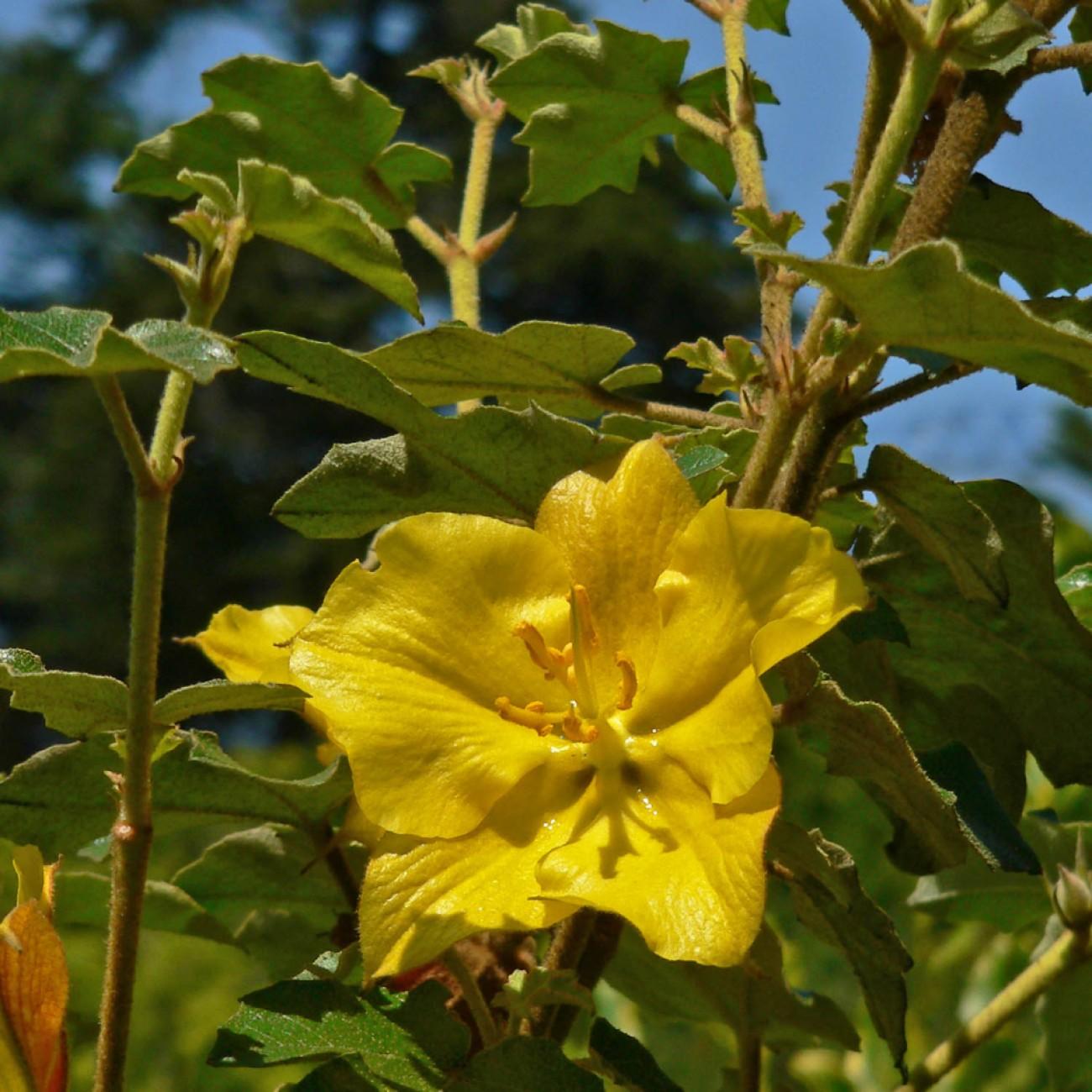
Flannel Bush, also called California Fremontia, is a fast-growing evergreen shrub named for the soft, fuzzy, gray-green hairs covering its leaves and stems, which give it a flannel-like texture. It produces abundant, showy, bright yellow to golden-orange cup-shaped flowers from spring to early summer, each up to 3 inches wide, that attract native bees, butterflies, and hummingbirds. Adapted to dry, rocky slopes and chaparral ecosystems, it is a staple of xeriscaping and native plant gardens in arid climates.
Care Guide
Watering
Flannel Bush is extremely drought-tolerant once established, requiring only occasional deep watering during extended hot, dry periods; overwatering, especially in heavy soils, will quickly lead to root rot. Newly planted specimens need regular, light watering for the first 1-2 years to help roots establish, but should be allowed to dry out completely between waterings. In regions with summer rainfall, supplemental watering is almost never needed for mature plants.
Light
This shrub requires full, direct sunlight for at least 6 hours per day to produce abundant blooms and maintain a dense, healthy growth habit. It will not thrive in partial shade, where it becomes leggy, produces far fewer flowers, and is more prone to fungal diseases. It tolerates intense, reflected sunlight from walls or pavement, making it ideal for hot, exposed landscape spots.
Soil
Flannel Bush requires sharply draining, low-fertility soil, preferably rocky, sandy, or gravelly loam with a neutral to slightly alkaline pH. It will not tolerate heavy clay soils or soils that retain moisture for long periods, as this leads to fatal root rot. It is adapted to nutrient-poor native soils, so amending with organic matter is generally unnecessary and can be harmful.
Fertilizer
Fertilizer is almost never required for Flannel Bush, as it is adapted to low-nutrient native soils, and added nutrients can lead to weak, leggy growth and reduced flowering. If growth appears extremely stunted, a single light application of low-nitrogen, slow-release fertilizer can be applied in early spring, but this is rarely needed. Over-fertilization increases the plant’s susceptibility to root rot and pest infestations.
Temperature
Flannel Bush thrives in hot, dry climates, tolerating temperatures up to 110°F (43°C) without damage once established. It is winter hardy to USDA zones 7-10, able to survive short periods of temperatures as low as 10°F (-12°C), though young plants may need frost protection in their first 1-2 years. It is poorly suited to humid, cool climates, where fungal diseases are a constant risk.
Pruning
Prune Flannel Bush in late winter or early spring before new growth emerges to shape the plant, remove dead or damaged branches, and encourage denser growth. Wear long sleeves, gloves, and eye protection when pruning, as the fine hairs on the plant’s foliage and stems can cause severe skin and respiratory irritation. Avoid heavy pruning of old, woody growth, as the plant does not resprout well from thick, bare branches.
Propagation
Flannel Bush is most commonly propagated from seed, which requires scarification (nicking or sanding the hard seed coat) and stratification (cold treatment for 1-2 months) to germinate reliably. Semi-hardwood cuttings taken in late summer can also be rooted, though success rates are lower, and cuttings should be treated with rooting hormone and kept in a well-draining medium under bright, indirect light. Transplant seedlings or rooted cuttings to their permanent location after the last frost, taking care not to disturb the delicate root system.
Humidity
Flannel Bush prefers low to moderate humidity levels between 20-50%, adapted to the dry air of its native chaparral and desert edge habitats. It struggles in high-humidity climates (over 60% average humidity), where prolonged moisture on foliage leads to powdery mildew and other fungal diseases. Good air circulation around the plant is critical to reduce humidity buildup and prevent disease in more humid regions.
Repotting
Flannel Bush is almost exclusively grown in landscape settings rather than containers, so repotting is rarely necessary. If grown in a large container for a short period, use a cactus or succulent potting mix with extra perlite for drainage, and repot only when roots are visibly growing out of the drainage holes, taking extreme care not to damage the fragile root system. Container-grown specimens have a much shorter lifespan than those planted in the ground, as they are far more prone to overwatering and root rot.
Uses & Symbolism
Flannel Bush is a popular ornamental plant for xeriscaping, native plant gardens, and erosion control on dry slopes, where its deep root system stabilizes soil and its bright flowers provide long-lasting seasonal color. Historically, Indigenous peoples of California used the plant’s flexible branches to make baskets and the inner bark to create cordage, though contact with foliage was avoided due to its irritating hairs. It is a valuable pollinator plant, supporting native bees, butterflies, and hummingbirds in arid region gardens.
Diseases & Pests
The most common issue for Flannel Bush is root rot, caused by overwatering or poorly draining soil, which causes wilting, yellowing foliage, and rapid plant death if not addressed immediately. In humid conditions or where air circulation is poor, powdery mildew and leaf spot fungi can develop, causing discolored, distorted foliage that may drop prematurely. Aphids and spider mites may occasionally infest new growth, though they are rarely a serious problem for healthy, well-sited plants, and can be controlled with a strong spray of water if needed.
Related plants
Other plants you might like if you grow Flannel Bush.