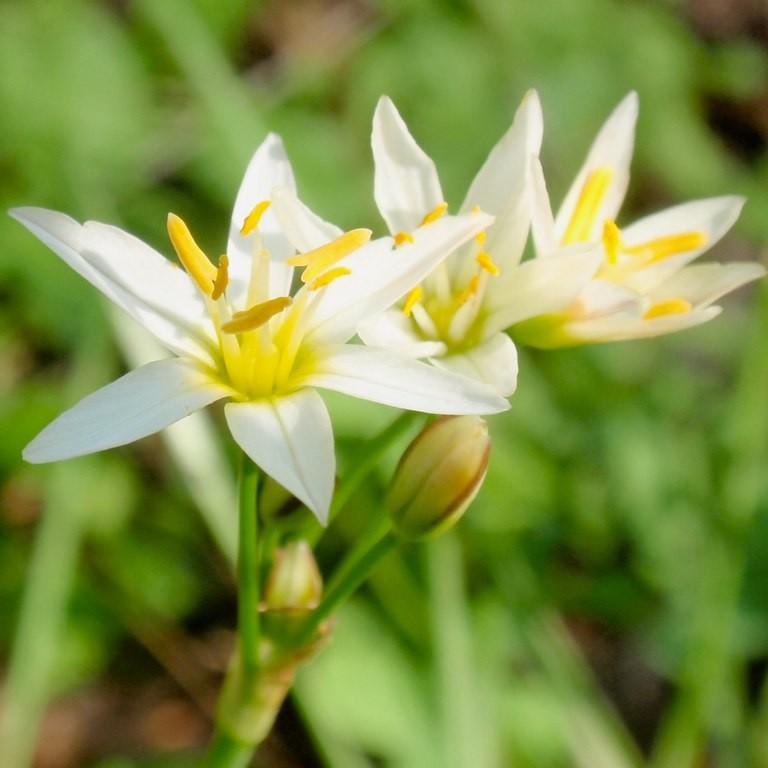
False Garlic
Nothoscordum bivalve
Overview
False garlic, also called crow poison, is a bulb-forming perennial that emerges in early spring, producing narrow, linear leaves and clusters of fragrant, white six-petaled flowers atop thin, leafless stalks. It is often mistaken for wild garlic or onion due to its similar foliage and growth habit, but lacks the characteristic allium scent when crushed. The plant spreads readily via small bulblets and self-seeding, making it a common sight in open, sunny areas across its native range.
Care Guide
Watering
False garlic is drought-tolerant once established, requiring only moderate moisture during its active spring growth period. Allow the soil to dry out completely between waterings once foliage dies back in late summer to prevent bulb rot. Reduce watering to almost nothing during its dormant fall and winter period.
Light
This plant thrives in full sun, requiring at least 6 hours of direct sunlight daily to produce abundant flowers. It can tolerate partial shade, though flowering may be reduced and growth may become leggy in low-light conditions. Indoor specimens should be placed in a south-facing window for maximum light exposure.
Soil
False garlic adapts to a wide range of soil types, including sandy, loamy, and clay soils, as long as drainage is excellent. It prefers a neutral to slightly alkaline pH between 6.5 and 7.5, but can tolerate mildly acidic conditions. Avoid heavy, waterlogged soils that can cause bulb rot during dormancy.
Fertilizer
False garlic has low nutrient needs and typically does not require regular fertilization when grown in average garden soil. A light application of balanced, slow-release fertilizer in early spring as new growth emerges can support healthy foliage and flowering for potted specimens. Do not fertilize after flowering ceases, as this can disrupt the plant’s natural dormancy cycle.
Temperature
This plant is hardy in USDA zones 4 through 9, tolerating winter temperatures as low as -30°F (-34°C) when bulbs are planted at the appropriate depth. It prefers mild spring temperatures between 60°F and 75°F (15°C to 24°C) for active growth. Hot summer temperatures above 90°F (32°C) will trigger foliage dieback and entry into dormancy.
Pruning
Pruning is minimal for false garlic; simply snip off spent flower stalks after blooming finishes if you wish to prevent self-seeding. Allow foliage to yellow and die back naturally in late summer, as the leaves are gathering energy to store in the bulb for the next growing season. Remove any brown, dead foliage in early fall to keep the planting area tidy.
Propagation
False garlic is most easily propagated by dividing bulb clusters in late summer or early fall, during the plant’s dormant period. Dig up mature clumps, separate the small offset bulblets from the parent bulb, and replant them 2 to 3 inches deep at a spacing of 4 to 6 inches. It can also be grown from seed sown in fall, though seed-grown plants will take 2 to 3 years to reach flowering maturity.
Humidity
False garlic is adapted to the moderate humidity levels of its native grassland and meadow habitats, tolerating a range of 30% to 60% relative humidity. It does not require supplemental humidity, and high humidity combined with poor air circulation can increase the risk of fungal leaf spot diseases. Indoor specimens should be kept in well-ventilated areas to prevent excess moisture buildup on foliage.
Repotting
Potted false garlic should be repotted every 2 to 3 years during dormancy, when bulbs have outgrown their container or become crowded. Gently remove the bulb cluster from the old pot, separate any excess offset bulblets, and replant in fresh, well-draining potting mix in a container with drainage holes. Ensure bulbs are planted 2 to 3 inches deep, with no more than 1 inch of soil covering the top of the bulb.
Uses & Symbolism
False garlic is sometimes used in native wildflower gardens and rock gardens for its delicate white spring blooms and low-maintenance growth habit, providing a nectar source for early-season pollinators including bees and butterflies. It is also utilized in erosion control plantings for sloped areas, as its bulbous root system helps stabilize soil. Note that it is not edible, and should not be planted in areas where foraging for wild alliums is common to avoid accidental ingestion.
Diseases & Pests
False garlic is largely pest and disease resistant, though it may occasionally be affected by bulb rot in poorly drained, waterlogged soils, which causes soft, mushy bulb tissue and stunted growth. Fungal leaf spot can occur in overly humid, crowded conditions, presenting as small brown spots on foliage; this can be managed by improving air circulation and avoiding overhead watering. Rarely, aphids may feed on new spring growth, which can be controlled with a strong spray of water or insecticidal soap.
Related plants
Other plants you might like if you grow False Garlic.