Camas
Camassia quamash
Overview
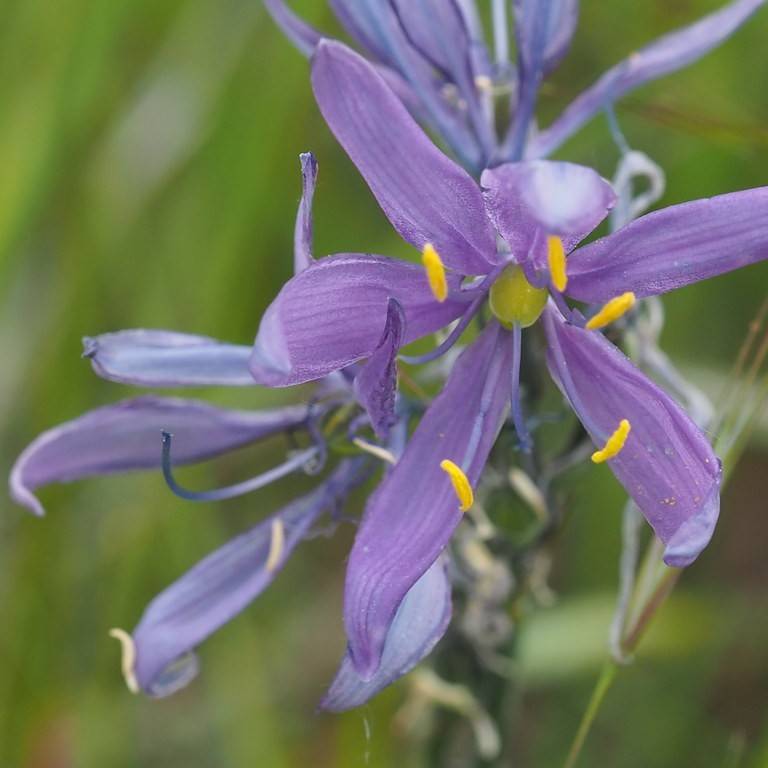
Camas thrives in moist meadows, prairies, and open woodland habitats across its native western North American range. It produces leafless flower stalks lined with star-shaped, six-petaled blooms that attract pollinators including bees, butterflies, and hummingbirds in late spring. For thousands of years, Indigenous communities have harvested and slow-roasted camas bulbs to convert their inulin content into sweet, digestible sugars, using the crop as a staple food source.
Care Guide
Watering
Camas prefers consistent moisture during its active spring growth period, requiring regular watering if rainfall is insufficient to keep soil evenly damp. Once flowering concludes and foliage begins to yellow in summer, reduce watering gradually to allow bulbs to enter a dry dormancy period, as overly wet soil during dormancy can cause rot. In naturalized settings, it adapts well to seasonal rainfall patterns without supplemental irrigation once established.
Light
Camas grows best in full sun to partial shade, with full sun exposure encouraging the most abundant flowering in cooler regions. In areas with hot, intense summer sun, light afternoon shade helps prevent premature foliage scorch and extends the growing season. Too much heavy, persistent shade will reduce bloom production and lead to lanky, weak stalks.
Soil
Well-drained, loamy, slightly acidic to neutral soil with high organic matter content is ideal for camas bulbs. It tolerates heavy clay soils better than many other bulb species, as long as standing water does not accumulate around bulbs during dormant periods. Amending heavy soils with compost or sand improves drainage and supports healthy bulb development.
Fertilizer
Camas does not require heavy fertilization, as it is adapted to low-nutrient native prairie soils. A light application of balanced, slow-release bulb fertilizer in early spring as new growth emerges provides sufficient nutrients for flowering and bulb expansion for the season. Over-fertilization can lead to excessive foliage growth at the expense of blooms, so avoid applying high-nitrogen formulations.
Temperature
Camas is extremely cold-hardy, tolerating winter temperatures as low as -30°F (-34°C), suitable for USDA hardiness zones 4 through 8. It requires a period of cold winter stratification, roughly 8 to 12 weeks of temperatures below 45°F (7°C), to trigger proper sprouting in spring. Hot summer temperatures during dormancy are well tolerated as long as bulbs are kept relatively dry.
Pruning
Pruning is minimal for camas; remove spent flower stalks after blooming if you wish to prevent self-seeding, or leave them intact to allow the plant to naturalize and spread in the landscape. Do not cut back yellowing foliage until it has completely died back in late summer, as the leaves continue to photosynthesize and store energy in the bulb for the next year’s growth. Remove any damaged or diseased foliage promptly to prevent the spread of pathogens.
Propagation
Camas is most easily propagated by dividing mature bulb clumps in late summer or early fall, once foliage has fully died back and bulbs are dormant. Separate small offset bulbs from the parent bulb, replant them at a depth three times the bulb’s height, and space them 4 to 6 inches apart. It can also be grown from seed, though seed-grown plants take 3 to 4 years to reach flowering maturity, and seeds require cold stratification for 3 months to germinate successfully.
Humidity
Camas adapts well to the moderate humidity levels common in its native range, tolerating both dry summer air and moist spring conditions without issue. High humidity combined with poor drainage during bulb dormancy increases the risk of fungal rot, so ensure soil is well-aerated if grown in humid climates. No extra humidity supplementation is needed for either garden or container-grown plants.
Repotting
When grown in containers, camas bulbs only need repotting every 3 to 4 years, or once the clump becomes overcrowded and bloom production declines. Repot during dormancy in late fall, using a well-draining bulb potting mix, and ensure bulbs are planted at a depth of three times their diameter, with 1 to 2 inches of space between individual bulbs. After repotting, water lightly once and keep the container cool until spring growth emerges.
Uses & Symbolism
Historically, camas was a core staple food for many Indigenous groups of the Pacific Northwest, with bulbs slow-roasted in pits for 1 to 3 days to break down indigestible inulin into sweet, edible sugars, often dried and stored for winter use. It is widely planted in native pollinator gardens, meadow restorations, and rain gardens for its showy spring blooms and ability to support local bee, butterfly, and hummingbird populations. It is also used as a cut flower, with its long, sturdy stalks and long-lasting blue blooms adding unique color to fresh floral arrangements.
Diseases & Pests
Camas is relatively pest and disease resistant, with the most common issue being bulb rot caused by poorly drained soil or excessive moisture during dormant periods. Aphids may occasionally feed on young, tender spring foliage, though they rarely cause significant damage and can be controlled with a strong spray of water or insecticidal soap if populations grow large. Slugs and snails may target young seedlings in damp conditions, so use organic slug bait or physical barriers to protect vulnerable new growth.
Related plants
Other plants you might like if you grow Camas.