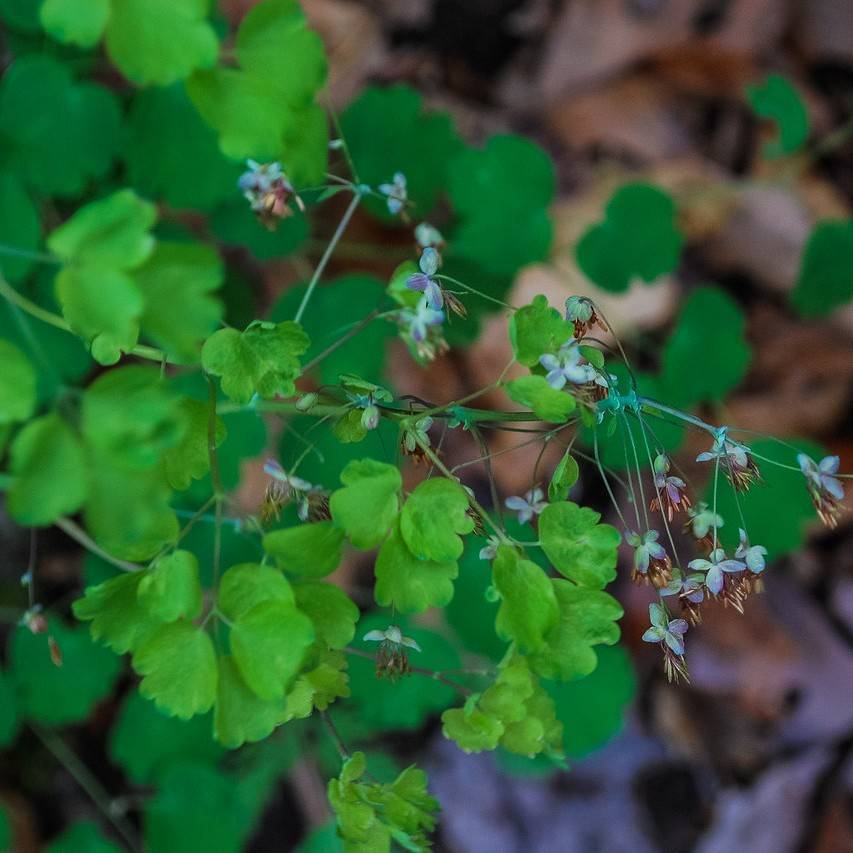
Early Meadow Rue
Thalictrum dioicum
Overview
Early meadow rue is a clumping, herbaceous perennial that emerges in early spring before woodland tree canopies fully leaf out, producing soft, blue-green, compound foliage that resembles columbine or fern fronds. It is dioecious, meaning male and female flowers appear on separate plants: male plants bear dangling, yellow-green to purplish tassel-like blooms with prominent stamens, while female plants produce upright, greenish-purple clusters of pistils. It spreads slowly via short rhizomes to form gentle, non-invasive colonies in ideal shaded conditions, making it a low-fuss addition to naturalized landscapes.
Care Guide
Watering
Early meadow rue prefers consistently moist, well-drained soil, and should be watered regularly during dry periods to prevent the soil from drying out completely, especially when grown in sunnier spots. It is moderately drought tolerant once established, but prolonged dry conditions will cause foliage to yellow and die back prematurely. Avoid overwatering or planting in waterlogged sites, as this can cause root rot.
Light
This species thrives in partial to full shade, making it ideal for shaded woodland gardens, north-facing beds, or areas under deciduous trees that receive dappled sunlight through most of the growing season. It can tolerate short periods of direct morning sun, but intense midday or afternoon sun will scorch its delicate foliage and cause it to wilt. Full sun exposure is only suitable in very cool, northern climates with consistently moist soil.
Soil
Early meadow rue grows best in rich, humusy, slightly acidic to neutral soil with high organic matter content that mimics its native woodland habitat. It adapts to loam, sandy loam, or silty loam soils as long as they drain well, and does not perform well in heavy, compacted clay that retains excess moisture. Amending planting sites with compost or leaf mold before planting will improve soil structure and nutrient content to support healthy growth.
Fertilizer
This native perennial rarely needs supplemental fertilizer if grown in organically rich soil; a top-dressing of compost or well-rotted leaf mold applied in early spring each year is typically sufficient to provide all necessary nutrients. If grown in poor, low-nutrient soil, a balanced, slow-release all-purpose fertilizer can be applied lightly once in early spring, but over-fertilization will cause leggy growth and reduce flowering. Avoid high-nitrogen fertilizers, as they will promote excessive foliage growth at the expense of blooms.
Temperature
Early meadow rue is adapted to temperate North American climates, and is hardy in USDA zones 3 through 7, tolerating winter temperatures as low as -40°F (-40°C) without protection. It prefers cool spring and summer temperatures, and will go dormant earlier than usual if exposed to extended periods of heat above 85°F (29°C) combined with dry soil. Mulching around the base of the plant in spring helps keep root zones cool and retain soil moisture during warm summer months.
Pruning
Pruning needs are minimal for early meadow rue: spent flower stalks can be cut back to the base of the plant after blooming finishes if you do not want it to self-sow, or left in place to allow seeds to mature and feed local bird populations. Foliage that yellows or dies back during hot summer months can be trimmed back to encourage fresh new growth if soil moisture is maintained. Cut back all dead foliage to the ground in late fall or early spring before new growth emerges to keep the planting area tidy.
Propagation
Early meadow rue is most easily propagated by dividing established clumps in early spring just as new growth emerges, or in fall after foliage dies back, ensuring each division has a healthy section of rhizome and several growing points. It can also be grown from seed sown directly outdoors in fall, as seeds require a period of cold stratification to germinate; fresh seed sown immediately after ripening in early summer will germinate the following spring. Seed-grown plants typically take 2 to 3 years to reach flowering maturity, and will produce a mix of male and female plants.
Humidity
This species prefers moderate to high humidity levels typical of its native woodland habitats, but adapts well to average home garden humidity levels as long as soil moisture is consistent. It does not tolerate dry, arid conditions well, so growing it in shaded, sheltered spots away from strong, drying winds will help maintain adequate ambient humidity around the foliage. Low humidity combined with full sun will cause leaf edges to brown and crisp prematurely.
Repotting
Early meadow rue is rarely grown in containers, as it prefers undisturbed root systems and spreads slowly via rhizomes in ground plantings. If grown in a pot, use a large, deep container with ample drainage holes, and repot every 2 to 3 years in early spring before new growth emerges, refreshing the soil with compost and moving to a slightly larger pot if the root system has filled the existing container. Ensure potted specimens are watered more frequently than in-ground plants, as container soil dries out faster.
Uses & Symbolism
Early meadow rue is a popular choice for native woodland gardens, shade borders, pollinator gardens, and naturalized areas, where its delicate foliage and early spring blooms provide early-season nectar for native bees, butterflies, and other pollinators. Its lacy foliage creates a soft textural contrast to bolder shade plants like hostas, astilbes, and bleeding hearts, and it is deer and rabbit resistant, making it suitable for areas with high wildlife pressure. Historically, some Indigenous North American tribes used small amounts of the plant for medicinal purposes, though it is not commonly used in modern herbalism due to potential toxicity in large doses.
Diseases & Pests
Early meadow rue is relatively pest and disease free when grown in its preferred conditions, though it can be susceptible to powdery mildew in areas with poor air circulation, high humidity, and dense shade, which presents as a white, powdery coating on foliage. Rust and leaf spot may occur if plants are grown in overly wet, poorly drained soil, causing brown or orange spots on leaves that can lead to premature defoliation. Slugs and snails may occasionally feed on young, tender foliage in damp, shaded spots, and can be controlled with handpicking, slug traps, or organic slug baits.
Related plants
Other plants you might like if you grow Early Meadow Rue.