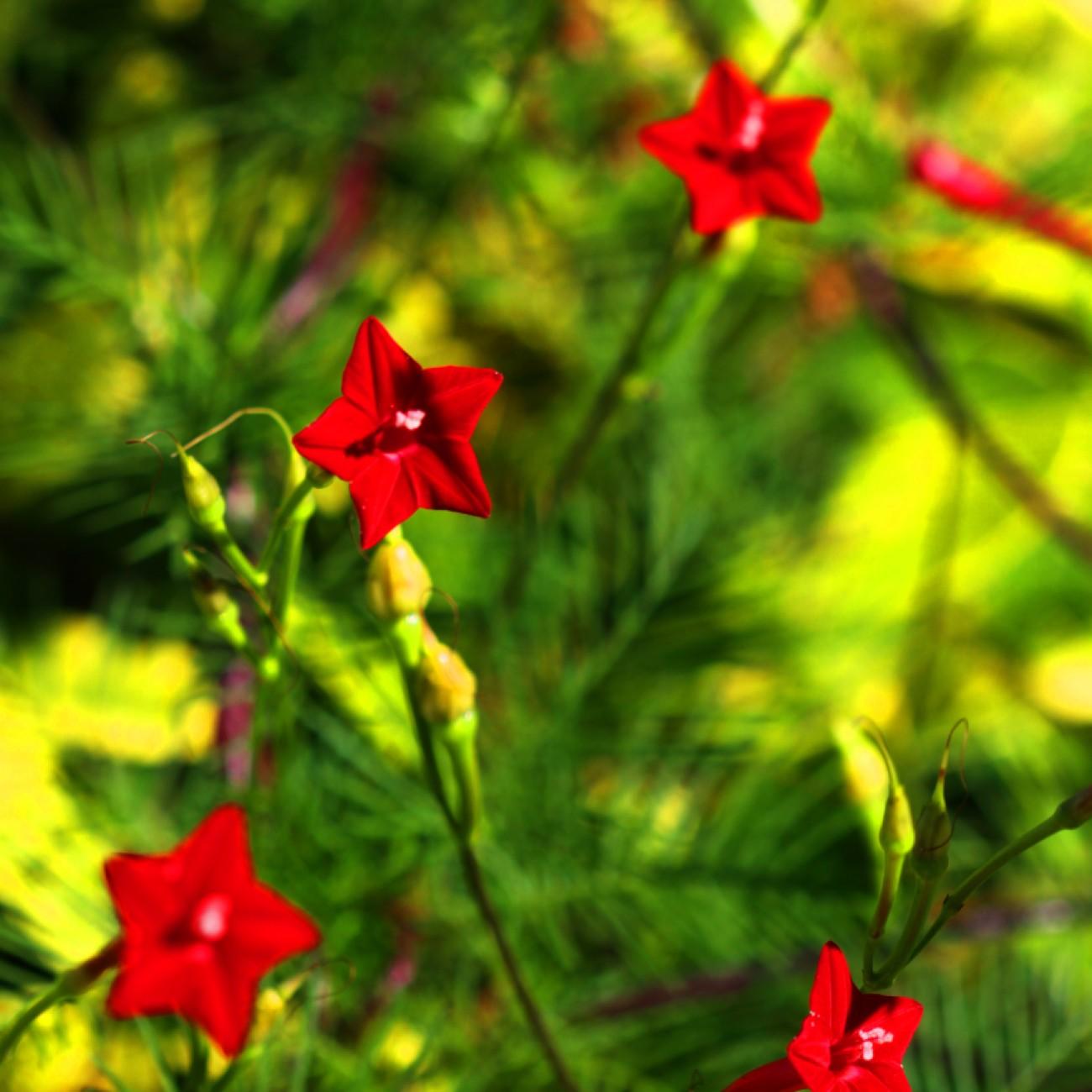
Cypress Vine
Ipomoea quamoclit
Overview
Cypress vine is a twining, herbaceous climber prized for its lacy, fern-like bright green leaves and clusters of small, trumpet-shaped flowers in shades of red, pink, or white that bloom continuously throughout warm months. A member of the morning glory family, it twines tightly around supports like trellises, fences, or arbors, creating a dense, decorative screen. It has naturalized in many warm temperate regions worldwide, though it is not considered aggressively invasive in most cultivated settings.
Care Guide
Watering
Water cypress vine regularly to keep soil consistently moist but not waterlogged, providing roughly 1 inch of water per week during active growth. Reduce watering frequency during periods of heavy rain to avoid root rot, and allow the top 1 inch of soil to dry slightly between waterings in cooler weather.
Light
Grow cypress vine in full sun, meaning at least 6 to 8 hours of direct, unfiltered sunlight per day for the most abundant flowering and dense foliage. It can tolerate partial shade, but growth will be sparser and bloom production will be significantly reduced in low-light conditions.
Soil
Cypress vine adapts to a wide range of well-drained soil types, from sandy loam to clay, but thrives in moderately fertile, loamy soil with a neutral to slightly acidic pH between 6.0 and 7.5. Avoid heavy, poorly draining soils that hold standing water, as this can cause root rot and stunted growth.
Fertilizer
Fertilize cypress vine once per month during the growing season with a balanced, all-purpose 10-10-10 fertilizer diluted to half strength to support steady growth and blooming. Avoid overfertilizing with high-nitrogen formulas, as this will encourage excessive leaf growth at the expense of flower production.
Temperature
Cypress vine thrives in warm temperatures between 70 and 85°F (21 and 29°C), and will grow rapidly once nighttime temperatures consistently stay above 60°F (15°C). It is highly frost-sensitive, and all above-ground growth will die back immediately if exposed to temperatures below 32°F (0°C).
Pruning
Prune cypress vine lightly throughout the growing season to remove dead or yellowed foliage, train growth to its support structure, and prevent it from spreading to unwanted areas. No heavy pruning is required, but you can cut back overgrown stems by up to one third in mid-season if the vine becomes too dense or unruly.
Propagation
Cypress vine is most easily propagated from seed, which can be sown directly outdoors after the last frost date or started indoors 4 to 6 weeks before the last expected frost for earlier blooms. Nick the hard seed coat with a file and soak seeds in warm water for 12 to 24 hours before sowing to speed up germination, which typically occurs in 7 to 14 days in warm soil.
Humidity
Cypress vine tolerates a wide range of humidity levels, growing well in average ambient humidity between 40 and 70% that is common in most garden settings. It does not require extra humidity, though very dry conditions may increase the risk of spider mite infestations on the delicate foliage.
Repotting
Cypress vine is typically grown directly in garden beds or large outdoor containers, as its extensive root system and rapid growth make it unsuitable for long-term indoor pot culture. If growing in containers, choose a pot at least 12 inches deep with drainage holes, and repot only if roots begin to emerge from the drainage holes during the growing season.
Uses & Symbolism
Cypress vine is widely used as an ornamental climber for trellises, arbors, fences, and obelisks, where its delicate foliage and bright flowers add vertical interest to garden beds and patio spaces. Its nectar-rich flowers are highly attractive to hummingbirds, bees, and butterflies, making it a popular addition to pollinator gardens. In some traditional medicine systems, extracts of the plant have been used topically to treat minor wounds and skin irritations, though internal consumption is not recommended due to its toxicity.
Diseases & Pests
Cypress vine is relatively pest and disease resistant, but may be susceptible to common garden pests like aphids, spider mites, and whiteflies, which can be controlled with insecticidal soap or neem oil sprays. Fungal diseases like powdery mildew and root rot may occur in overly wet, poorly ventilated conditions, so avoid overwatering and ensure adequate space between plants for air circulation.
Related plants
Other plants you might like if you grow Cypress Vine.