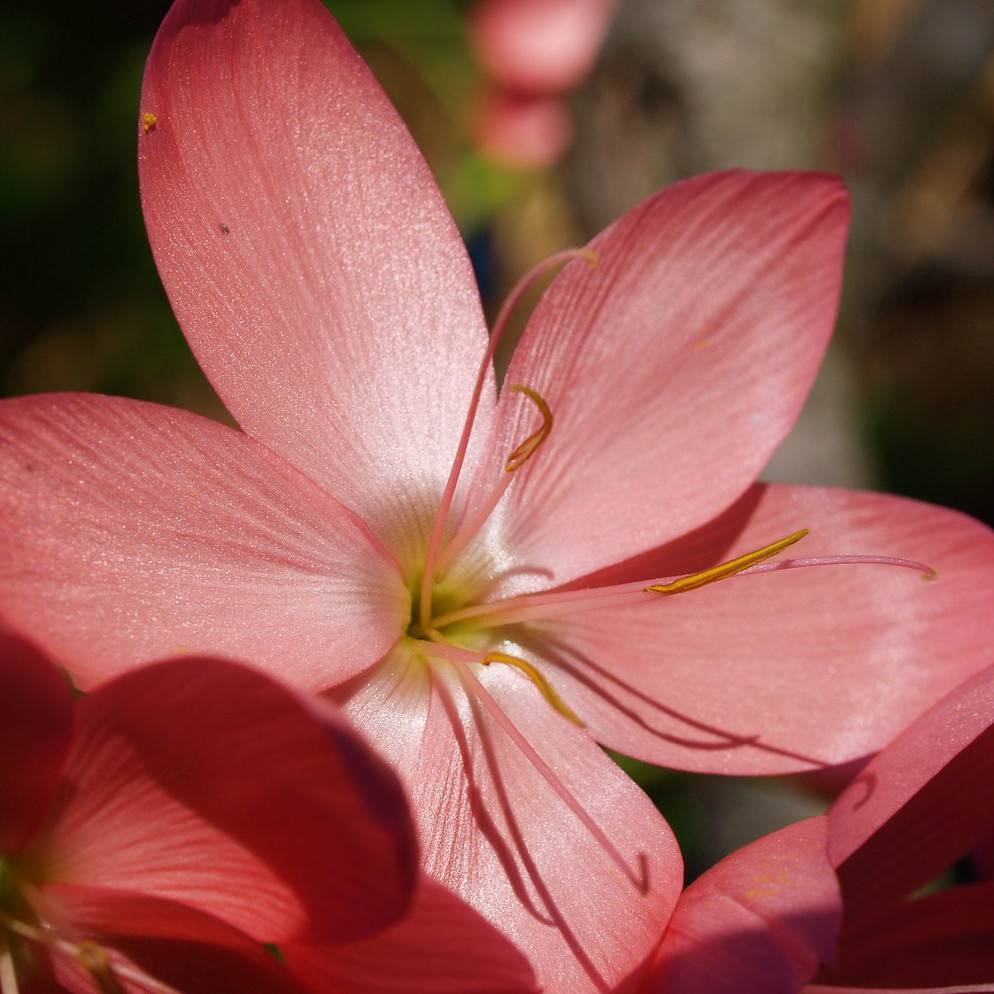
Crimson Flag
Schizostylis coccinea (syn. Hesperantha coccinea)
Overview
Crimson flag, also called crimson flag lily or river lily, is a herbaceous perennial native to South Africa’s damp riparian habitats. It produces narrow, sword-shaped green foliage that forms dense, upright clumps, with slender, branching flower spikes rising above the leaves in late summer. Each spike holds multiple star-shaped, vivid crimson blooms (occasionally pink or white in cultivars) that open sequentially for an extended display lasting until the first frost. It has become a popular garden ornamental in temperate regions for its late-season color and tolerance of wet soils.
Care Guide
Watering
Crimson flag requires consistently moist, even wet soil throughout the growing season, and will not tolerate prolonged drought. Water deeply and regularly, especially during dry spells, to keep the root zone saturated; it thrives in areas where soil stays damp year-round, such as near ponds or rain gardens. Reduce watering slightly in winter, but do not let the soil dry out completely even during dormancy.
Light
This plant grows best in full sun, which encourages the most abundant flower production and sturdy, upright growth. It can tolerate partial shade, especially in regions with very hot, intense summer sun, but flowering may be reduced and stems may become leggy without at least 6 hours of direct sunlight daily. In cooler temperate climates, full sun exposure is ideal for optimal performance.
Soil
Crimson flag prefers fertile, humus-rich, loamy soil with a neutral to slightly acidic pH, and requires excellent moisture retention without becoming waterlogged in cold winter conditions. It adapts well to heavy clay soils that hold moisture, as long as winter drainage is sufficient to prevent root rot in freezing temperatures. Amend poor soils with well-rotted compost or leaf mold before planting to boost organic content and improve moisture-holding capacity.
Fertilizer
Feed crimson flag in early spring as new growth emerges, using a balanced, slow-release granular fertilizer to support foliage development and future flowering. Apply a second light dose of a potassium-rich fertilizer in mid-summer to encourage robust flower spikes and extended bloom time. Avoid over-fertilizing with high-nitrogen products, which can lead to excessive foliage growth at the expense of flowers.
Temperature
It is hardy in USDA zones 8 to 10, tolerating minimum temperatures down to 10°F (-12°C) if provided with a thick winter mulch for insulation. In regions with colder winters, it can be grown in containers and moved to a frost-free, cool location over winter, or lifted and stored in a cool, dark place before the first hard frost. It thrives in summer temperatures between 60°F and 80°F (15°C to 27°C), and may struggle in extended periods of extreme heat above 90°F (32°C) without extra water and partial shade.
Pruning
Remove spent flower spikes regularly throughout the bloom season to encourage additional flowering and keep the plant looking tidy. Cut back faded foliage to ground level in late fall or early winter once it has yellowed and died back naturally, to make space for new spring growth. Thin out overcrowded clumps every 3 to 4 years during division to maintain good air circulation and prevent disease.
Propagation
Crimson flag is most easily propagated by division in early spring, just as new growth begins to emerge; lift mature clumps, separate them into smaller sections with healthy roots and growth points, and replant immediately at the same depth as the original plant. It can also be grown from seed sown in containers in fall or early spring, though seed-grown plants may take 2 to 3 years to reach flowering size, and cultivars will not come true from seed. Take basal cuttings from young spring growth if division is not feasible, rooting them in moist, well-drained potting mix under indirect light.
Humidity
This plant tolerates a wide range of humidity levels, and thrives in the moderate humidity typical of temperate garden environments. It does not require extra humidity when grown outdoors, as long as its soil moisture needs are consistently met. When grown indoors as a potted plant, average household humidity between 40% and 60% is sufficient, with occasional misting recommended in very dry indoor conditions.
Repotting
Container-grown crimson flag should be repotted every 2 to 3 years in early spring, before new growth starts, to refresh the soil and prevent root binding. Use a rich, loamy potting mix with added peat moss or compost to retain moisture, and select a pot with drainage holes to prevent winter waterlogging. When repotting, divide overcrowded clumps if desired to produce new plants, and replant sections at the same depth they were growing previously.
Uses & Symbolism
Crimson flag is widely planted as an ornamental in perennial borders, rain gardens, pond edges, and stream banks, where its bright red late-season blooms add vivid color when many other plants have finished flowering. Its long, sturdy stems and long-lasting blooms make it an excellent cut flower for fresh floral arrangements, with individual blooms opening sequentially in vases for up to two weeks. In its native South Africa, it has been used in traditional medicine to treat digestive ailments and minor wounds, though it is not widely used for medicinal purposes in other regions.
Diseases & Pests
Crimson flag is relatively pest and disease resistant, but may be susceptible to root rot if grown in poorly drained soil, especially during cold, wet winter conditions. Aphids and spider mites may occasionally infest foliage, particularly on stressed plants grown in dry conditions, and can be controlled with insecticidal soap or a strong jet of water to dislodge the pests. Rust and leaf spot fungal diseases may occur in humid, poorly ventilated conditions, and can be prevented by spacing plants properly to improve air circulation and avoiding overhead watering.
Related plants
Other plants you might like if you grow Crimson Flag.