Douglas Water Hemlock
Cicuta douglasii
Overview
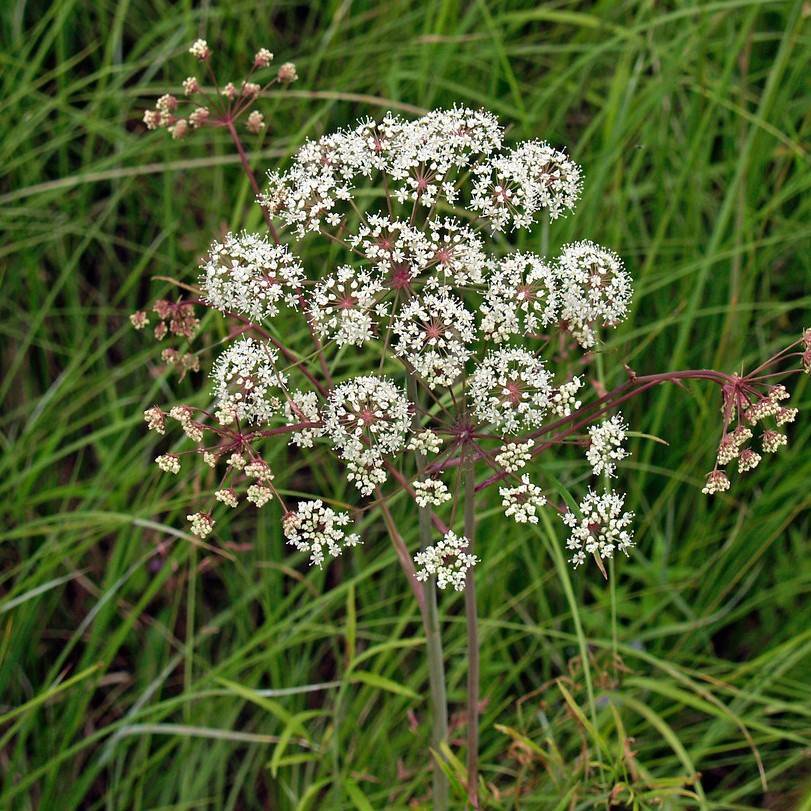
Douglas Water Hemlock is a robust herbaceous perennial that thrives in wet, marshy habitats including stream banks, meadows, and pond edges across western North America. It produces large, flat-topped umbels of tiny white flowers in summer, and has hollow, purple-splotched stems and divided, fern-like leaves that resemble edible relatives like parsnips or celery, leading to accidental poisonings. Widely considered one of the most toxic native plants in North America, it poses a significant risk to foraging livestock and unaware foragers.
Care Guide
Watering
Requires consistently moist to saturated soil, as it naturally grows in wetland and riparian habitats; never allow the soil to dry out completely, and it can tolerate shallow standing water for extended periods. In cultivation, water frequently to maintain saturated conditions, especially during warm, dry weather.
Light
Grows best in full sun to partial shade, with full sun promoting more vigorous growth and more abundant flowering. It can tolerate dappled shade near tree lines in riparian zones, but prolonged deep shade will stunt growth and reduce bloom production.
Soil
Prefers rich, loamy, neutral to slightly acidic wetland soil with high organic matter content; it adapts to silty or clay-heavy soils as long as they stay consistently moist. Well-draining soil is not required, as it thrives in waterlogged conditions that would rot most other plant species.
Fertilizer
Generally does not require supplemental fertilization in its native habitat, as it obtains sufficient nutrients from organic-rich wetland soils. If grown in poor, low-organic soil, a light application of balanced, slow-release fertilizer in early spring can support healthy growth, but over-fertilization should be avoided.
Temperature
Adaptable to the cool to temperate climates of its native range, thriving in USDA hardiness zones 4 through 9. It tolerates cold winter temperatures down to -30°F (-34°C), dying back to the root system in winter and resprouting from underground tubers in spring.
Pruning
Pruning is not required for health, but spent flower heads can be removed to prevent unwanted self-seeding, as the plant spreads readily via seed in suitable moist conditions. Always wear gloves when handling any part of the plant to avoid accidental contact with toxic sap, and never burn pruned material, as toxic fumes can be released.
Propagation
Most commonly propagated by seed, sown directly in wet, cold soil in late fall to allow for natural cold stratification over winter; seeds require several months of cold, moist conditions to germinate successfully. It can also be propagated by dividing the tuberous root system in early spring before new growth emerges, taking extreme care to avoid contact with toxic root tissue.
Humidity
Tolerates a wide range of humidity levels, as long as soil moisture remains consistent. It thrives in the moderate to high humidity common in riparian and wetland environments, but can adapt to drier air if the root zone is kept constantly saturated.
Repotting
Rarely grown in containers due to its large size and high moisture needs, but if potted, use a large, deep container to accommodate its extensive tuberous root system. Repot only when roots become severely root-bound, in early spring before new growth starts, using a rich, loamy potting mix that retains moisture well.
Uses & Symbolism
Due to its extreme toxicity, Douglas Water Hemlock has no edible or medicinal uses, and intentional cultivation is generally discouraged outside of specialized native plant restoration projects for wetland habitats. In its native range, it provides minor ecological value as a nectar source for native pollinators including bees and butterflies, and its dense root systems help stabilize eroding stream banks.
Diseases & Pests
Douglas Water Hemlock is relatively resistant to most common plant diseases and pests, though it may occasionally be affected by aphids that feed on new stem and leaf tissue, which can be controlled with insecticidal soap if necessary. Overly dry conditions can cause leaf scorch and stress, while root rot is not a concern even in saturated soils, as the plant is adapted to waterlogged environments.
Related plants
Other plants you might like if you grow Douglas Water Hemlock.