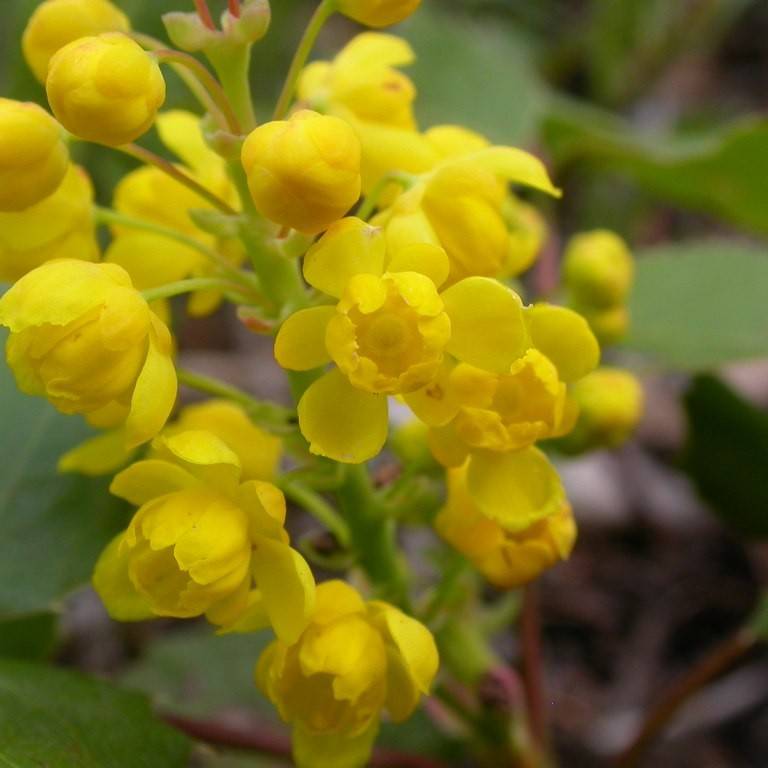
Creeping Mahonia
Mahonia repens
Overview
Creeping mahonia is a drought-tolerant groundcover shrub native to forest understories, rocky slopes, and open woodlands of western North America. Its glossy, leathery leaves turn striking bronze-red in cold winter months, adding year-round visual interest to landscapes. Clusters of fragrant yellow flowers emerge in early spring, followed by powdery blue berries that ripen in late summer.
Care Guide
Watering
Water newly planted creeping mahonia regularly for the first growing season to establish a deep root system, keeping soil evenly moist but not waterlogged. Once established, it is highly drought-tolerant, requiring only occasional watering during extended dry periods, and will suffer from root rot if overwatered. Avoid wetting the foliage when watering to reduce fungal disease risk.
Light
Thrives in partial to full shade, making it ideal for understory plantings and shaded garden beds. It can tolerate full sun in cooler climates, but exposure to intense afternoon sun in warmer regions will scorch its leaves and slow growth. Too much direct sunlight will also cause its winter foliage color to be less vibrant.
Soil
Prefers well-drained, slightly acidic to neutral loam or sandy soil with a pH between 5.0 and 7.0, but adapts readily to poor, rocky, or clay soils as long as they do not stay saturated. Amending heavy soil with compost or peat moss at planting time will improve drainage and support healthier root development. It tolerates shallow, nutrient-poor soils better than many other groundcover shrubs.
Fertilizer
Requires minimal fertilization; a light application of balanced, slow-release shrub fertilizer in early spring before new growth emerges is sufficient for healthy plants. Over-fertilizing will lead to excessive, leggy growth that reduces its natural spreading, low-growing habit and makes it more susceptible to pest damage. Avoid fertilizing after mid-summer, as this can stimulate tender new growth that will be damaged by early fall frost.
Temperature
Adaptable to USDA hardiness zones 4 through 8, tolerating winter temperatures as low as -30°F (-34°C) without significant damage. It prefers cool summer temperatures and will struggle in regions with consistent high heat above 90°F (32°C) if not provided with adequate shade and moisture. Mild, humid summers support its most vigorous growth, but it tolerates dry air well once established.
Pruning
Requires very little pruning; remove any dead, damaged, or diseased stems in early spring before new growth appears to maintain a tidy appearance. If it spreads beyond its desired planting area, you can trim back overhanging stems to the base in late winter to control its spread, as it resprouts readily from root systems. Avoid heavy pruning that removes more than one-third of the plant in a single season, as this can stress the shrub.
Propagation
Most easily propagated by dividing mature clumps in early spring or late fall, carefully separating rooted stem sections from the parent plant and replanting them at the same depth they were growing. It can also be grown from seed collected from ripe berries in late summer, but seeds require 3-4 months of cold stratification to germinate, and seedlings grow very slowly in their first two years. Softwood cuttings taken in early summer can root successfully if treated with rooting hormone and kept in moist, shaded conditions for 2-3 months.
Humidity
Tolerates a wide range of humidity levels, thriving in the moderate humidity of its native mountain and forest habitats as well as drier air in semi-arid regions. Very high humidity combined with poor air circulation can increase the risk of fungal leaf spots and powdery mildew, so space plants adequately to allow airflow between them. It does not require misting or supplemental humidity when grown in garden settings or as a potted plant.
Repotting
Rarely grown in containers, but if potted, repot every 2-3 years in early spring before new growth starts, using a well-drained acidic potting mix designed for shrubs. Choose a wide, shallow pot to accommodate its spreading root system, and ensure the pot has multiple drainage holes to prevent waterlogging. When repotting, gently loosen tangled roots and trim any excessively long or rotted root sections to encourage healthy new growth.
Uses & Symbolism
Widely used as a low-maintenance, erosion-controlling groundcover for shaded slopes, woodland gardens, and under large trees where turf grass struggles to grow. Its tart, vitamin C-rich berries are edible when cooked, often used to make jellies, jams, and fermented beverages, and are a critical food source for birds, small mammals, and pollinators. Native American tribes historically used its bark and roots for medicinal purposes to treat fevers, digestive issues, and skin conditions, thanks to its high berberine content.
Diseases & Pests
Relatively pest and disease resistant, but can develop fungal leaf spots, powdery mildew, and rust in conditions of high humidity, poor air circulation, and excessive moisture on foliage. Common pests include aphids, scale insects, and spider mites, which suck sap from leaves and stems, causing yellowing and stunted growth; these can be controlled with insecticidal soap or neem oil applications. Root rot is the most serious issue, occurring when plants are grown in poorly drained, waterlogged soil, so proper site selection with good drainage is critical to prevent this fatal condition.
Related plants
Other plants you might like if you grow Creeping Mahonia.