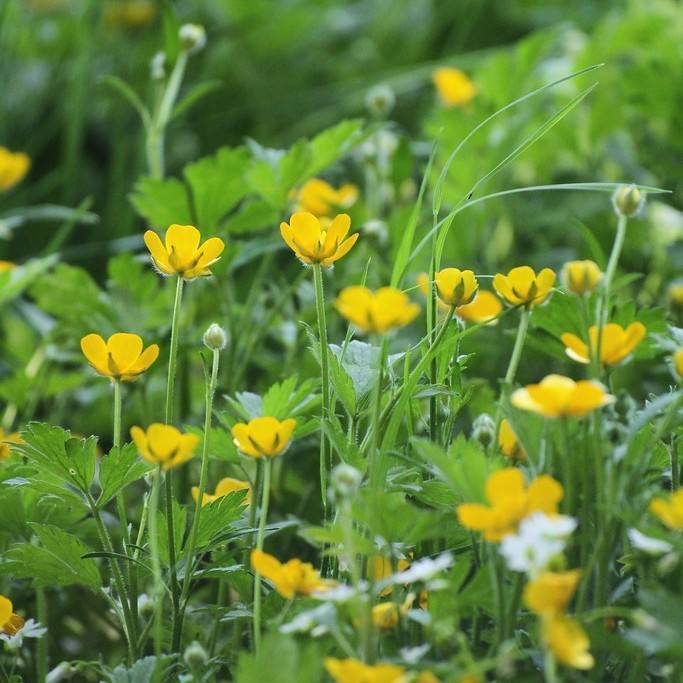
Creeping Buttercup
Ranunculus repens
Overview
Creeping buttercup is a mat-forming herbaceous perennial distinguished by its glossy, deeply lobed three-part leaves and bright, shiny yellow five-petaled flowers that bloom from late spring to early fall. It spreads via long, rooting stolons that grow along the soil surface, allowing it to quickly colonize disturbed areas, lawns, and wet meadows. While sometimes grown as an ornamental ground cover in controlled settings, it is classified as a noxious invasive weed in parts of North America, Australia, and New Zealand where it outcompetes native vegetation.
Care Guide
Watering
Creeping buttercup thrives in consistently moist soil and tolerates temporary waterlogging, making it well suited to areas with poor drainage. Water regularly to keep the soil from drying out completely, though established plants can tolerate short periods of drought. Reduce watering during the winter dormant period in colder climates to prevent root rot.
Light
This adaptable plant grows best in full sun to partial shade, producing the most abundant blooms when exposed to at least 4-6 hours of direct sunlight daily. It can survive in deep shade but will produce fewer flowers and spread more slowly as it directs energy to stem and leaf growth. In extremely hot climates, provide afternoon shade to prevent leaf scorch.
Soil
Creeping buttercup is not fussy about soil type and can grow in clay, loam, or sandy substrates, though it prefers heavy, moist, slightly acidic soils with a pH between 5.5 and 7.0. It tolerates nutrient-poor soils well, though it will spread more aggressively in fertile, amended substrates. Avoid planting it in fast-draining, sandy soils that dry out rapidly unless you can provide frequent irrigation.
Fertilizer
Fertilization is rarely necessary for creeping buttercup, as it can thrive in low-nutrient soils without supplemental feeding. If growing it as an ornamental, apply a balanced, slow-release 10-10-10 fertilizer once in early spring to encourage lush growth and flowering, but avoid over-fertilizing, as this will lead to excessive, invasive spread. Skip fertilization entirely if you are trying to limit its spread in a garden setting.
Temperature
Creeping buttercup is hardy in USDA zones 3 through 9, tolerating winter temperatures as low as -40°F (-40°C) and summer highs up to 90°F (32°C). It dies back to the ground in areas with severe winter frost, regrowing from its extensive root system in early spring. In regions with extremely hot summers, it may go partially dormant during the hottest months if moisture is limited.
Pruning
Prune creeping buttercup regularly to control its spread, trimming back stolons that extend beyond desired planting areas and pulling up unwanted rooted runners as they appear. Deadhead spent flowers if you want to prevent self-seeding, though most spread occurs via vegetative runners rather than seed. If the plant becomes unkempt, cut it back to 2 inches above the soil line in late fall or early spring to encourage fresh, dense growth.
Propagation
Creeping buttercup is most easily propagated by dividing rooted stolons in early spring or fall, when the plant is actively growing. Simply cut a section of stem that has developed its own root system, replant it in moist soil, and water thoroughly until it is established. It can also be grown from seed sown directly in the garden in early spring, though seed-grown plants will take longer to mature and flower than vegetative cuttings.
Humidity
This plant tolerates a wide range of humidity levels, thriving in average outdoor humidity between 40% and 80% without special accommodations. It can handle high humidity in wetland or riparian areas, as long as there is adequate air circulation around the foliage to prevent fungal diseases. It does not perform well in arid, low-humidity environments unless provided with frequent watering and shade.
Repotting
If growing creeping buttercup in containers to control its spread, repot every 1-2 years in early spring, or when roots begin to grow through the drainage holes of the pot. Choose a wide, shallow container to accommodate its spreading growth habit, and use a standard potting mix with added perlite to improve drainage. Trim back excess roots and runners during repotting to keep the plant contained to its container.
Uses & Symbolism
Historically, creeping buttercup has been used in traditional folk medicine to treat rheumatism, headaches, and skin conditions, though its toxic properties make internal consumption unsafe. It is occasionally planted as a fast-spreading ornamental ground cover for damp, shaded areas where other plants struggle to grow, though it requires strict containment to prevent escape into wild areas. Its bright flowers also provide a nectar source for early-season pollinators including bees and butterflies.
Diseases & Pests
Creeping buttercup is relatively resistant to most pests and diseases, though it can be affected by powdery mildew and rust fungal infections in areas with high humidity and poor air circulation. Aphids and slugs may occasionally feed on its tender new foliage, though damage is rarely severe enough to require treatment. Root rot can occur in poorly drained soils if the plant is exposed to prolonged waterlogging during cold weather.
Related plants
Other plants you might like if you grow Creeping Buttercup.