Common Buckthorn
Rhamnus cathartica
Overview
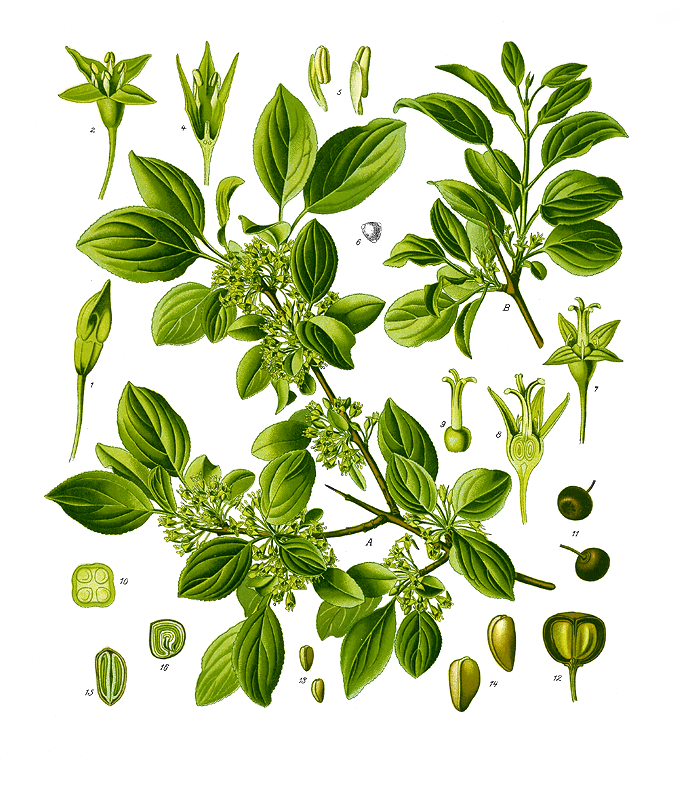
Common buckthorn is a hardy deciduous woody plant recognizable by its toothed, oval leaves, small greenish-yellow spring flowers, and clusters of glossy black berries that ripen in late summer. Introduced to North America as an ornamental hedge plant in the 1800s, it has become a highly aggressive invasive species across much of the northern United States and southern Canada, outcompeting native understory plants and altering soil chemistry to favor its own growth. It is a host for soybean aphids and the oat crown rust fungus, posing additional risks to agricultural crops in affected regions.
Care Guide
Watering
Common buckthorn is highly drought-tolerant once established, requiring only occasional supplemental watering during prolonged dry spells; it thrives in both consistently moist and moderately dry soil conditions. Overwatering is rarely a concern for this resilient species, as it adapts well to fluctuating moisture levels in its environment. In cultivated settings, it can survive with natural rainfall alone in most temperate regions.
Light
This species tolerates full sun to full shade, though it grows most vigorously and produces the most fruit in full sun exposures. Its ability to thrive in low-light understory conditions allows it to invade intact forested areas, where it outshades native seedling plants. For ornamental use (though not recommended in regions where it is invasive), it can be planted in almost any light condition without major growth issues.
Soil
Common buckthorn adapts to nearly all soil types, including sandy, loamy, clay, and alkaline soils, making it exceptionally adaptable to diverse environments. It prefers well-drained soils but tolerates occasional waterlogging, with no specific pH requirements to support healthy growth. Its tolerance for poor, compacted soils contributes to its ability to colonize disturbed sites, roadsides, and neglected urban areas.
Fertilizer
This hardy species requires no supplemental fertilization to thrive, as it can extract sufficient nutrients from even low-fertility soils. Overfertilization can lead to excessive, leggy growth that may make the plant more prone to breakage in windy conditions. In ornamental settings where growth is desired to be controlled, avoid applying any fertilizer entirely.
Temperature
Common buckthorn is cold-hardy in USDA zones 3 through 8, tolerating winter temperatures as low as -40°F (-40°C) without damage. It adapts well to a wide range of temperate summer conditions, withstanding high heat and humidity as long as soil moisture is at least minimally available. Extreme heat above 100°F (38°C) may cause temporary leaf wilt, but the plant typically recovers quickly once temperatures moderate.
Pruning
Pruning is rarely required for common buckthorn, though it can be cut back heavily to maintain a hedge shape if grown ornamentally in regions where it is not prohibited. For removal in invasive management areas, cut the plant down to the ground and treat the stump with an appropriate herbicide to prevent resprouting, as this species regrows vigorously from cut root systems. Prune in late winter or early spring before new growth emerges to minimize stress on the plant.
Propagation
Common buckthorn propagates primarily from seed, which is widely dispersed by birds that eat its nutrient-poor berries and excrete the seeds in new locations. Seeds can remain viable in the soil seed bank for up to six years, leading to new infestations long after mature plants are removed. It can also propagate vegetatively from root sprouts, allowing a single plant to form dense, monospecific thickets over time.
Humidity
This species tolerates a wide range of humidity levels, from dry continental climates to moist maritime environments, with no specific humidity requirements to support growth. It shows no susceptibility to humidity-related diseases, making it adaptable to almost any temperate climate. Very high, sustained humidity may slightly increase the risk of foliar fungal spots, but this rarely impacts the overall health of the plant.
Repotting
Common buckthorn is almost never grown in containers, as its extensive, fast-spreading root system quickly outgrows even large pots. If planted temporarily in a container for erosion control or other restricted use, repot every 1 to 2 years in early spring before new growth begins, using a general-purpose potting mix with good drainage. For long-term growth, plant directly in the ground in regions where it is not classified as an invasive species.
Uses & Symbolism
Historically, common buckthorn bark and berries were used in traditional medicine as a strong purgative and laxative, though this practice is now discouraged due to the risk of toxic side effects. Its dense, thorny growth was once popular for ornamental hedges and windbreaks in North America, though it is now banned for sale and cultivation in many U.S. states and Canadian provinces due to its invasive status. The hard, fine-grained wood is occasionally used for small woodworking projects, carving, and making charcoal.
Diseases & Pests
Common buckthorn is relatively resistant to most pests and diseases, though it is a known alternate host for soybean aphid (Aphis glycines) and oat crown rust (Puccinia coronata), both of which cause significant economic damage to agricultural crops. It may occasionally develop leaf spot or powdery mildew in overly wet, poorly ventilated conditions, but these issues rarely cause significant harm to the plant itself. Scale insects and aphids may feed on its foliage occasionally, but infestations are typically mild and do not require intervention for the plant’s survival.
Related plants
Other plants you might like if you grow Common Buckthorn.