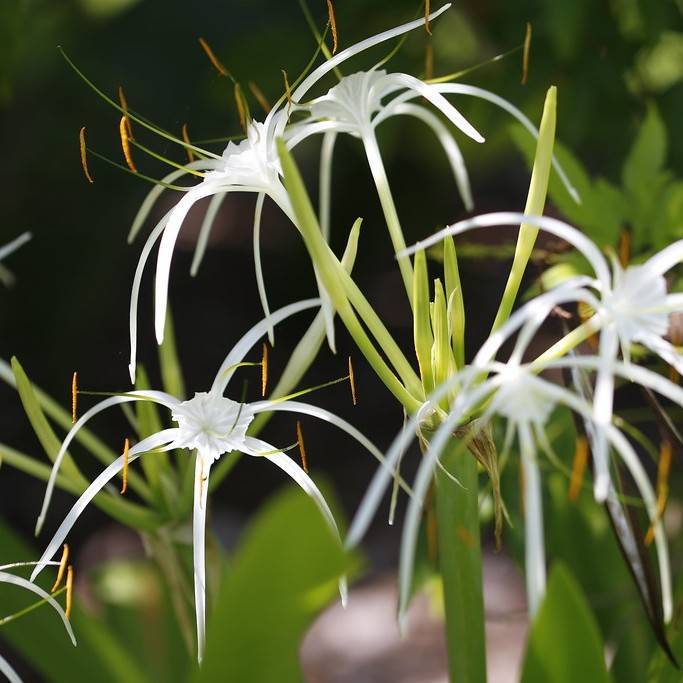
Cayman Islands Spider Lily
Hymenocallis caymanensis
Overview
Endemic to the coastal limestone habitats of Grand Cayman, Little Cayman, and Cayman Brac, the Cayman Islands Spider Lily is a bulbous perennial prized for its striking, fragrant white flowers. Each bloom features six narrow, curved tepals and a central trumpet-shaped corona, giving it the characteristic spidery form shared by other Hymenocallis species. It is classified as near threatened in its native range due to habitat loss from coastal development, making cultivated specimens important for conservation efforts.
Care Guide
Watering
Keep soil consistently moist but not waterlogged during the active growing season from spring to fall, reducing watering frequency in winter when the plant enters dormancy. Avoid allowing the bulb to sit in standing water, as this can lead to bulb rot, a common issue for amaryllid family members.
Light
Thrives in full sun to partial shade, with dappled afternoon shade recommended in regions with intense, hot summer sun to prevent leaf scorch. Indoor specimens require bright, indirect light for a minimum of 6 hours per day to support healthy growth and flowering.
Soil
Requires well-draining, fertile sandy or loamy soil with a slightly alkaline to neutral pH between 6.5 and 7.5, mimicking its native limestone coastal habitat. For container growth, use a mix of potting soil, coarse sand, and crushed limestone to improve drainage and adjust pH appropriately.
Fertilizer
Feed with a balanced, slow-release granular fertilizer formulated for flowering bulbs in early spring as new growth emerges, and again after flowering to support bulb development for the next season. Avoid over-fertilizing with high-nitrogen formulas, as this can encourage excessive leaf growth at the expense of blooms.
Temperature
Prefers warm tropical to subtropical temperatures between 65 and 85°F (18 and 29°C) during the growing season, and can tolerate brief dips down to 30°F (-1°C) if protected from frost. In regions with regular freezing temperatures, grow in containers and overwinter indoors in a cool, dry location above 40°F (4°C).
Pruning
Remove spent flower stalks at the base after blooming finishes to redirect energy back to the bulb, and trim away yellowed or damaged leaves as needed throughout the growing season. Cut back all foliage to ground level once it dies back naturally in late fall to prepare the plant for winter dormancy.
Propagation
Most commonly propagated by dividing offset bulbs from the parent plant during the dormant season in late winter, replanting offsets at the same depth as the parent bulb in well-draining soil. Can also be grown from seed, though seed-grown plants take 3 to 4 years to reach flowering maturity, making division the preferred method for home growers.
Humidity
Adaptable to average to high humidity levels between 50% and 70%, matching its native Caribbean coastal environment, and tolerates brief periods of lower humidity without significant stress. Indoor-grown specimens may benefit from occasional misting during very dry winter months to prevent leaf tip browning.
Repotting
Container-grown specimens should be repotted every 2 to 3 years during dormancy, when the bulb clump outgrows its current pot and drainage holes become crowded with roots. Handle bulbs carefully during repotting to avoid damaging the fleshy root system, and plant at the same depth as in the previous container to prevent rot.
Uses & Symbolism
Primarily grown as an ornamental plant in tropical and subtropical gardens, where its fragrant, showy white blooms add visual interest to borders, coastal landscapes, and container displays. Its rarity and conservation status also make it a popular specimen in botanical garden collections focused on Caribbean endemic flora, supporting ex-situ conservation efforts.
Diseases & Pests
Susceptible to bulb rot caused by overwatering or poorly draining soil, which can be prevented by ensuring proper drainage and avoiding saturated growing conditions. Common pests include aphids, spider mites, and amaryllis borers, which can be controlled with horticultural oil or appropriate insecticides, and regular inspection to catch infestations early.
Related plants
Other plants you might like if you grow Cayman Islands Spider Lily.