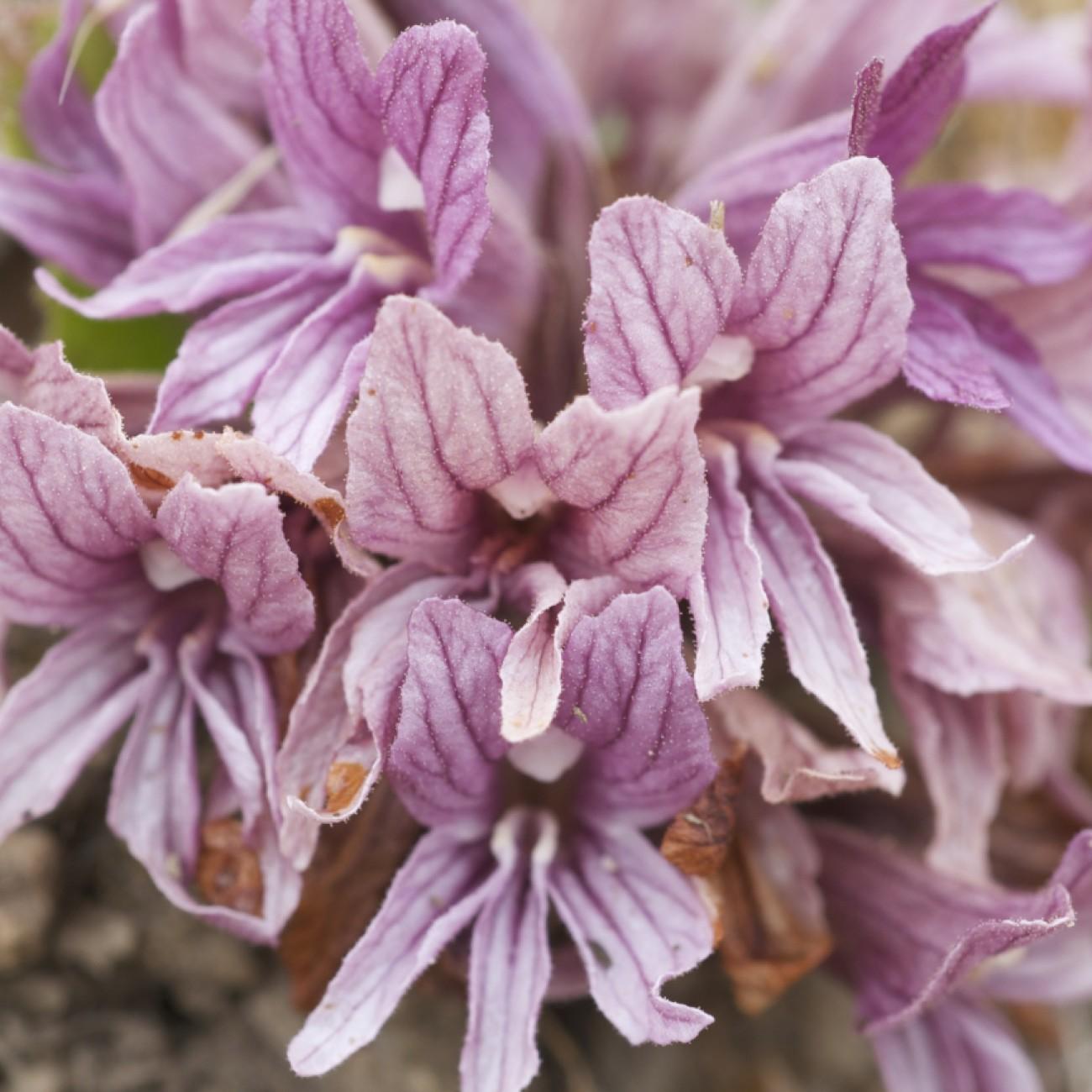
California Broomrape
Orobanche californica
Overview
California Broomrape is a holoparasitic plant that lacks chlorophyll, so it cannot photosynthesize and relies entirely on host plants, typically species in the Asteraceae family such as sagebrush, sunflowers, and goldenrods, for all water and nutrients. It produces unbranched, fleshy stems that range in color from pale yellow to deep purple-brown, topped with dense spikes of two-lipped, tubular flowers that are usually lavender, pink, or cream in color. This plant is adapted to a wide range of western North American habitats, including grasslands, chaparral, coastal bluffs, and open woodlands, and it emerges only to flower and set seed, spending most of its lifecycle underground attached to host roots.
Care Guide
Watering
As a parasitic plant, California Broomrape obtains all required moisture from its host plant, so no direct watering of the broomrape itself is necessary; its water needs are fully met by the host’s regular water uptake. Any irrigation should be tailored to the specific host species’ requirements, as overwatering or underwatering the host will directly impact the health of the attached broomrape. In natural settings, it thrives in areas with seasonal rainfall patterns typical of its native western North American range.
Light
California Broomrape does not require light for photosynthesis, as it lacks chlorophyll and obtains all energy from its host plant, so it can grow in full sun to partial shade conditions as long as its host plant is healthy. It will emerge and flower successfully regardless of light levels, as long as the host receives the light it needs to produce sufficient nutrients for both itself and the parasite. When cultivating it, light requirements are entirely dictated by the needs of the specific host species being used.
Soil
California Broomrape does not require specific soil conditions for its own growth, as it attaches directly to the roots of its host plant, so soil quality only matters insofar as it supports the health of the host. It is most commonly found in well-drained, loamy to sandy soils that are suitable for its common Asteraceae hosts, and it can tolerate a wide range of soil pH levels from slightly acidic to slightly alkaline. Soil must be loose enough to allow the tiny broomrape seeds to germinate near host roots and establish haustorial connections to the host’s root system.
Fertilizer
No direct fertilization of California Broomrape is required, as it extracts all necessary nutrients, including nitrogen, phosphorus, and potassium, from its host plant’s vascular system. Fertilization should be applied only to the host plant, following the specific nutrient requirements of that species, to ensure it produces enough resources to support both itself and the parasitic broomrape. Excess fertilizer applied to the host may encourage excessive host foliage growth at the expense of supporting the attached broomrape, so follow moderate fertilization schedules for the host.
Temperature
California Broomrape is adapted to the temperature ranges of its native western North American habitats, tolerating winter lows down to 10°F (-12°C) and summer highs up to 100°F (38°C) as long as its host plant remains healthy. It germinates in spring when soil temperatures rise above 50°F (10°C), coinciding with active root growth of its host plants, and flowers throughout late spring to mid-summer before setting seed and dying back in fall. Frost during the flowering period may damage flower spikes and reduce seed production, but underground connections to the host are usually unaffected by short cold snaps.
Pruning
Pruning is not required for California Broomrape, as it is a small, short-lived annual that dies back completely after setting seed. If you wish to prevent self-seeding and spread to other host plants, you can remove spent flower spikes before seed pods mature and split open to release the tiny, dust-like seeds. Any pruning of foliage should be restricted to the host plant, as removing the broomrape’s stem will kill the individual parasite, though it will not harm the established host plant.
Propagation
California Broomrape is propagated exclusively from tiny, dust-like seeds that require exposure to chemical signals exuded from the roots of a suitable host plant to germinate, making intentional propagation very challenging outside of natural settings. To propagate, collect mature seed pods in late summer before they split, store the seeds in a cool, dry place over winter, and sow them directly into the soil near the roots of a healthy, established host plant in early spring. Germination rates are very low even under ideal conditions, as seeds must come into contact with host root exudates within a short window to trigger growth and form the necessary haustorial connections to the host’s root system.
Humidity
California Broomrape tolerates a wide range of humidity levels, from the low humidity of inland desert margins to the higher humidity of coastal bluff habitats, as it obtains all moisture from its host plant. It has no specific humidity requirements of its own, and humidity only impacts the broomrape indirectly through its effect on the health of the host plant. When cultivated, maintain humidity levels within the optimal range for the specific host species being used to support robust host growth and, in turn, healthy broomrape development.
Repotting
Repotting is not applicable for California Broomrape in most cases, as it is an annual plant that completes its entire lifecycle within a single growing season and is permanently attached to its host’s root system. If repotting the host plant is necessary, take extreme care to avoid damaging the roots where the broomrape is attached, as breaking this connection will kill the parasite. It is not recommended to attempt to transplant an established California Broomrape separate from its host, as it cannot survive independent of its nutrient source.
Uses & Symbolism
California Broomrape has a long history of use as a food source by Indigenous peoples of western North America, with the fleshy, starchy root crowns eaten raw, boiled, or roasted as a nutrient-dense vegetable. Ecologically, it serves as a specialized host for several native bee species, including specialist oligolectic bees that only feed on the nectar and pollen of Orobanche species, and it plays a minor role in regulating populations of common Asteraceae host plants in natural ecosystems. It is occasionally grown in native plant gardens and ecological restoration projects to support specialized pollinators and increase plant community diversity in its native range.
Diseases & Pests
California Broomrape is relatively free of most common plant diseases, though it may be affected by root rot pathogens if its host plant is grown in overly saturated, poorly drained soil that causes host root decay. Aphids and thrips may occasionally feed on its soft flower spikes and stems, though infestations are rarely severe and usually do not require treatment, as the plant is short-lived. As a parasite, it can itself act as a minor pest in agricultural settings if it establishes on crop species in the Asteraceae family, such as sunflowers or lettuce, though it is not considered a major agricultural pest in its native range.
Related plants
Other plants you might like if you grow California Broomrape.