Broadleaf Cattail
Typha latifolia
Overview
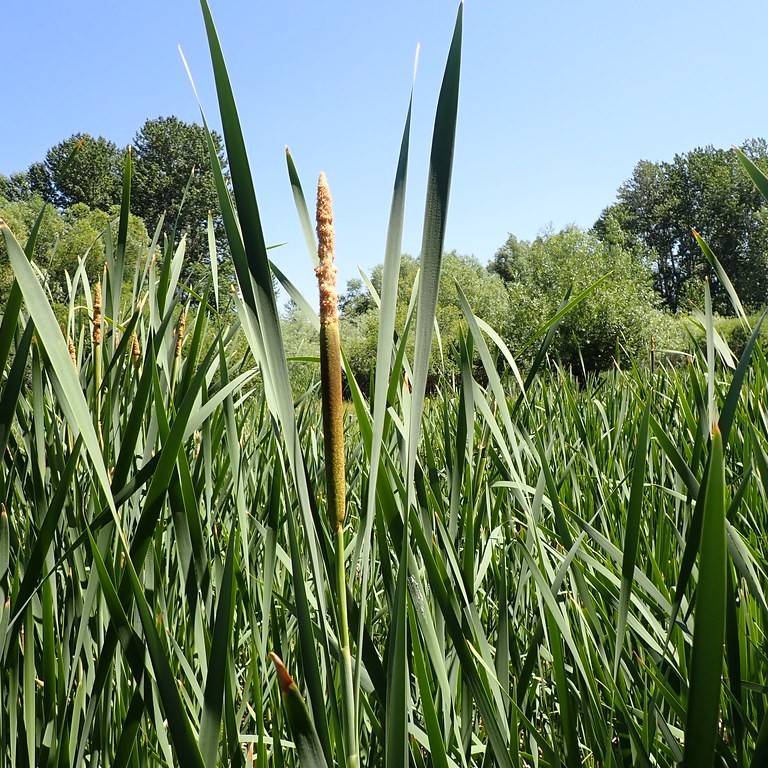
Broadleaf cattail is a iconic wetland plant easily recognized by its tall, upright growth and dense, brown cylindrical fruiting spikes that persist through winter. It forms extensive colonies via creeping rhizomes, stabilizing shorelines and providing critical habitat for wildlife including waterfowl, amphibians, and insects. Adaptable to fluctuating water levels, it is a common sight in marshes, pond edges, and slow-moving streams across its native range.
Care Guide
Watering
Requires consistently saturated or shallowly submerged soil, with water levels ranging from just below the soil surface to 12 inches deep for mature plants. Never allow the root zone to dry out completely; supplement natural rainfall in dry periods to maintain consistent moisture for established specimens.
Light
Thrives in full sun, requiring a minimum of 6 hours of direct sunlight daily for optimal growth and flower spike production. It can tolerate partial shade, but growth will be stunted and fewer fruiting spikes will form in low-light conditions.
Soil
Prefers heavy, nutrient-rich loam or clay soil that holds moisture well, with a pH between 5.0 and 8.0. It can tolerate brackish water up to 2 ppt salinity, but grows best in fresh, non-saline wetland soil with high organic matter content.
Fertilizer
Generally does not require supplemental fertilization in natural wetland environments, as it draws nutrients efficiently from sediment and water. If grown in a garden pond or container, apply a slow-release aquatic plant fertilizer once annually in early spring to support robust new growth.
Temperature
Adaptable to a wide range of temperatures, thriving in USDA hardiness zones 3 through 10. It dies back to the root zone in freezing winter conditions, but rhizomes remain viable under ice and saturated soil, resprouting vigorously when spring temperatures rise above 60°F (15°C).
Pruning
Cut back dead foliage and spent seed spikes to ground level in late winter or early spring before new growth emerges to keep stands tidy and prevent excessive self-seeding. If growing in a contained pond or garden, trim spreading rhizomes annually to prevent the plant from overtaking smaller desired aquatic species.
Propagation
Most easily propagated by dividing mature rhizomes in early spring before new growth starts, separating sections with at least one active growing point and planting directly in saturated soil at the same depth as the parent plant. It can also be grown from seed sown on the surface of wet, warm soil in spring, though seedlings take 2-3 years to reach full maturity and produce seed spikes.
Humidity
Tolerates very high humidity levels common in wetland environments, with no issues related to high moisture in the air. It can withstand temporary periods of lower humidity as long as its root zone remains fully saturated, making it adaptable to outdoor pond settings in most temperate climates.
Repotting
If grown in a container for pond use, repot every 2-3 years in early spring to refresh the soil and trim back overgrown rhizomes that have filled the pot. Use a heavy, loam-based aquatic potting mix and line the pot with burlap to prevent soil from leaching into surrounding pond water.
Uses & Symbolism
Broadleaf cattail has a long history of edible use, with young shoots, rhizomes, pollen, and immature seed spikes all harvestable for human consumption when properly prepared. Ecologically, it is used for wetland restoration, shoreline erosion control, and phytoremediation to filter pollutants from contaminated water sources. Dried seed spikes are a popular addition to cut flower arrangements, and the plant’s dense foliage provides nesting material and shelter for a wide range of wetland wildlife.
Diseases & Pests
Broadleaf cattail is relatively pest and disease resistant, though it may be susceptible to fungal leaf spots and rust in overly humid, poorly ventilated stands. Common pests include cattail caterpillars and aphids, which may feed on foliage but rarely cause significant long-term damage to healthy plants. Overly dense stands can experience dieback from oxygen depletion in saturated sediment, which can be mitigated by occasional thinning of older growth.
Related plants
Other plants you might like if you grow Broadleaf Cattail.