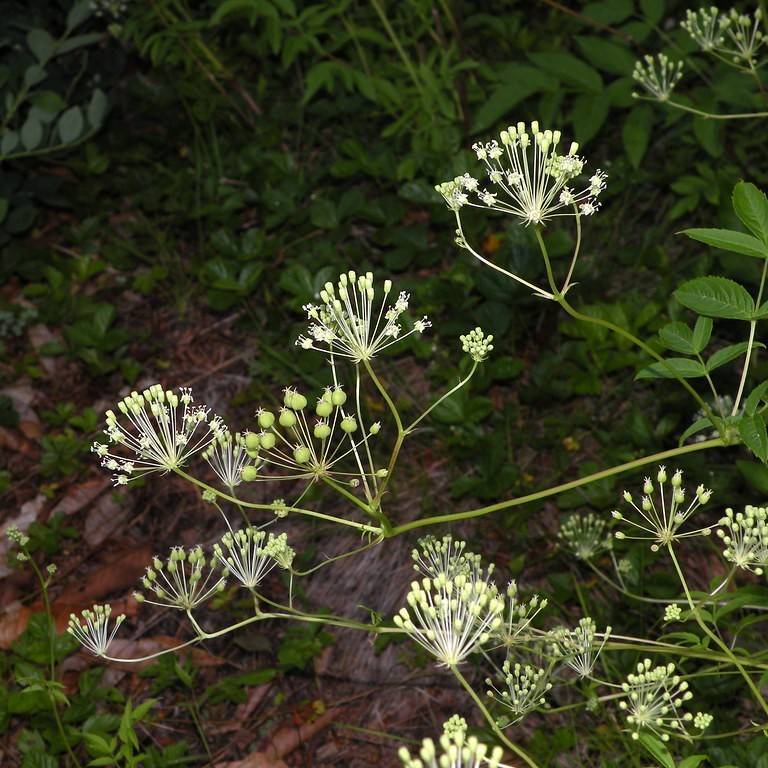
Bristly Sarsaparilla
Aralia hispida
Overview
Bristly sarsaparilla is a deciduous, colony-forming perennial distinguished by its stiff, bristle-covered woody stems and large, pinnately compound leaves that turn yellow in autumn. It produces round clusters of small, creamy-white flowers in early summer, which mature into clusters of dark purple, berry-like drupes by late summer. Adapted to a range of harsh, open habitats, it spreads via thick, aromatic rhizomes that form extensive clonal colonies over time.
Care Guide
Watering
Bristly sarsaparilla prefers consistently moist, well-drained soil but tolerates moderate drought once established, making it suitable for dry, sandy sites. Water deeply during prolonged dry spells, avoiding overwatering that can lead to root rot in poorly drained locations. Reduce supplemental watering in fall as the plant enters dormancy.
Light
It thrives in full sun to partial shade, with the most robust flowering and berry production occurring in sites receiving at least 6 hours of direct sunlight daily. In warmer southern parts of its range, it benefits from light afternoon shade to prevent leaf scorch during peak summer heat. Too much deep shade will lead to leggy growth and reduced fruiting.
Soil
This adaptable plant grows best in slightly acidic to neutral, sandy or loamy soils with good drainage, but it tolerates poor, dry, gravelly, or rocky soils where many other plants struggle. It does not perform well in heavy, waterlogged clay soils that hold excess moisture around its rhizomes. Amending heavy soils with sand or organic matter can improve drainage to support healthy growth.
Fertilizer
Bristly sarsaparilla has low nutrient requirements and rarely needs supplemental fertilization, especially when grown in its native habitat. A light application of balanced, slow-release fertilizer in early spring can be beneficial if grown in extremely poor, nutrient-depleted soils. Over-fertilization will lead to excessive, weak foliage growth at the expense of flowering and berry production.
Temperature
It is extremely cold-hardy, suitable for USDA zones 3 through 8, tolerating winter temperatures as low as -40°F (-40°C) without protection. It adapts to summer temperatures across its native range, though extended periods above 90°F (32°C) may cause temporary leaf wilt if soil moisture is low. Dormancy is triggered by cool fall temperatures, with stems dying back to the ground in winter in colder regions.
Pruning
Prune back dead, damaged, or overly crowded stems in late winter or early spring before new growth emerges to improve air circulation and encourage fresh, healthy growth. To control spread of its clonal colonies, dig up and remove unwanted rhizome sections in early spring or fall, taking care to extract the entire rhizome to prevent regrowth. Spent flower clusters can be removed after blooming if self-seeding is unwanted, though leaving them supports local wildlife.
Propagation
The easiest method of propagation is by division of established rhizome clumps in early spring before new growth starts or in late fall after dormancy begins. It can also be grown from seed, which requires a 3-month period of cold stratification to break dormancy, sown outdoors in fall or refrigerated before spring sowing. Seed-grown plants typically take 2 to 3 years to reach maturity and produce flowers.
Humidity
Bristly sarsaparilla tolerates a wide range of humidity levels common across its native North American range, from dry upland sites to moderately humid woodland edges. It does not require supplemental humidity and is resistant to drought-related leaf drop when established. Extremely high, constant humidity combined with poor air circulation may increase risk of foliar fungal diseases.
Repotting
Bristly sarsaparilla is rarely grown in containers, as its spreading rhizome system requires ample space to expand. If grown in a large pot, repot every 2 to 3 years in early spring, trimming back overgrown rhizomes and using a well-drained, sandy potting mix. Choose a pot with ample drainage holes to prevent waterlogging, which can quickly kill the plant’s rhizomes.
Uses & Symbolism
Historically, the aromatic rhizomes of bristly sarsaparilla were used by Indigenous peoples and early settlers as a diuretic, blood purifier, and flavoring for root beers and medicinal teas, though it is not related to true tropical sarsaparilla. Its dense foliage and summer berries provide food and cover for a variety of wildlife, including birds, small mammals, and pollinators that feed on its nectar-rich flowers. It is used in native plant landscaping for erosion control on dry, sloped sites, and as a low-maintenance groundcover for naturalized areas and wildlife gardens.
Diseases & Pests
Bristly sarsaparilla is relatively pest and disease resistant, though it may occasionally be affected by leaf spot, powdery mildew, or rust in conditions of high humidity and poor air circulation. Common pests include aphids, spider mites, and scale insects, which can be controlled with insecticidal soap or neem oil applications if infestations become severe. Overwatering or poorly drained soil can lead to root rot, which is the most common cause of plant death in cultivation.
Related plants
Other plants you might like if you grow Bristly Sarsaparilla.