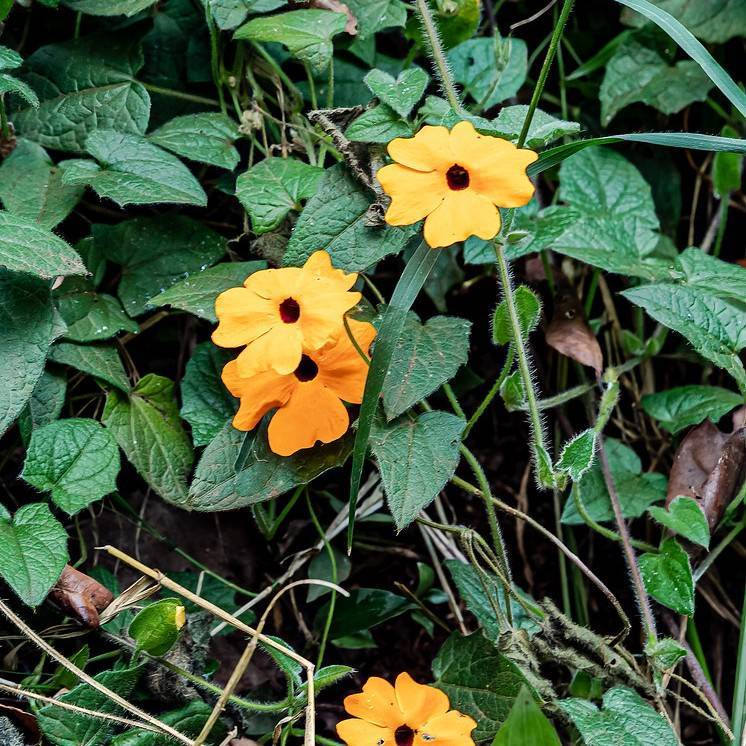
Black-Eyed Susan Vine
Thunbergia alata
Overview
Black-eyed Susan vine is a trailing or climbing tender perennial prized for its prolific, cheerful blooms that appear continuously from early summer until the first frost. Its five-petaled flowers come in shades of yellow, orange, white, and apricot, each marked by a distinct dark brown or black central eye that gives the plant its common name. While it is evergreen and perennial in frost-free tropical and subtropical climates, it is most often grown as an annual in temperate regions where winter temperatures drop below 30°F (-1°C). Its vining growth habit makes it extremely versatile for both vertical and cascading planting applications.
Care Guide
Watering
Water black-eyed Susan vine regularly to keep the soil consistently moist but not waterlogged, as soggy roots can quickly lead to root rot. Allow the top 1 inch of soil to dry out between waterings during cooler, cloudy periods to reduce overwatering risk, and cut back on watering frequency in winter if grown as an indoor houseplant. Container-grown specimens may need daily watering during hot, dry summer spells to maintain adequate moisture levels.
Light
This vine thrives in full sun, meaning at least 6 hours of direct, unfiltered sunlight per day, which encourages the most abundant and vibrant flower production. It can tolerate partial shade, especially in regions with intense midday summer heat, but too much shade will result in leggy growth and significantly reduced blooming. Indoor plants should be placed in a bright south or west-facing window to receive sufficient light year-round.
Soil
Black-eyed Susan vine prefers fertile, well-draining soil with a slightly acidic to neutral pH range of 6.0 to 7.5 for optimal growth. A general-purpose potting mix amended with compost or well-rotted manure works well for container plantings, while garden beds should be loosened and amended with organic matter to improve drainage and nutrient content before planting. Avoid heavy, clay-heavy soils that retain excess moisture, as these can cause rapid root decline.
Fertilizer
Feed outdoor plants every 2 to 3 weeks during the active growing season with a balanced, water-soluble fertilizer diluted to half the recommended strength to support steady growth and blooming. Use a fertilizer with a slightly higher phosphorus content (such as a 5-10-5 blend) to encourage more prolific flower production rather than excessive leafy growth. Avoid over-fertilizing, as too much nitrogen will lead to lush foliage at the expense of blooms, and stop fertilizing entirely in late summer to prepare the plant for cooler weather.
Temperature
This tropical vine grows best in temperatures between 60°F and 85°F (15°C to 29°C), and will suffer damage if exposed to temperatures below 30°F (-1°C) for even short periods. It can tolerate brief dips down to 32°F (0°C) but will die back to the ground if exposed to frost, making it suitable as a warm-season annual in temperate climates. Indoor specimens should be kept away from cold drafts from windows or air conditioning vents, and maintained at consistent room temperatures for best health.
Pruning
Prune black-eyed Susan vine as needed throughout the growing season to control its size, remove dead or yellowing foliage, and trim back overly long, leggy stems to encourage bushier, more compact growth. Pinch back the growing tips of young plants early in the season to promote branching and a fuller growth habit that will produce more flowers. If grown as a perennial, cut the entire plant back by one-third to one-half in late winter or early spring before new growth emerges to refresh its form.
Propagation
Black-eyed Susan vine is most easily propagated from seed, which can be sown directly in the garden after all danger of frost has passed, or started indoors 6 to 8 weeks before the last expected frost date for earlier blooms. Softwood stem cuttings can also be taken from healthy, non-flowering stems in late spring or early summer, rooted in moist potting mix with bottom heat, and potted up once a strong root system has developed. Seeds germinate in 10 to 14 days when kept at temperatures between 70°F and 75°F (21°C and 24°C), and young plants can be transplanted outdoors once they have developed 2 to 3 sets of true leaves.
Humidity
This vine tolerates average ambient humidity levels between 40% and 60%, which is typical of most indoor and outdoor growing environments, and does not require extra humidity in most cases. In extremely arid climates or dry indoor heated environments during winter, occasional misting of the foliage can help prevent leaf tip browning and keep the plant looking vibrant. Avoid high, prolonged humidity levels combined with poor air circulation, as this can increase the risk of fungal leaf spot diseases.
Repotting
Container-grown black-eyed Susan vines grown as annuals typically do not require repotting during their single growing season, but if grown as a perennial houseplant, repot every 1 to 2 years in early spring before new growth begins. Choose a pot that is 1 to 2 inches larger in diameter than the current container, with ample drainage holes to prevent waterlogging, and use fresh, nutrient-rich potting mix when repotting. Gently loosen the root ball before placing it in the new container to encourage roots to spread into the new soil, and water thoroughly after repotting to settle the soil around the roots.
Uses & Symbolism
Black-eyed Susan vine is a popular ornamental plant used to cover trellises, arbors, fences, and obelisks in garden beds, adding vertical interest and long-lasting color to warm-season landscapes. Its trailing growth habit makes it ideal for hanging baskets, window boxes, and spilling over the edges of raised planters, where its bright blooms can be enjoyed at eye level. It is also grown as a houseplant in bright, sunny indoor spaces, where it can be trained up small supports or allowed to trail from shelves or hanging planters for year-round greenery and blooms.
Diseases & Pests
Black-eyed Susan vine is relatively pest and disease resistant, but it can be susceptible to aphids, spider mites, and whiteflies, especially when grown in dry, low-humidity conditions or indoors with poor air circulation. Fungal diseases such as powdery mildew and leaf spot can occur if the foliage is consistently wet, or if plants are spaced too closely together with inadequate air flow between specimens. Root rot is the most common serious issue, caused by overwatering or planting in poorly draining soil, and can be prevented by allowing the top layer of soil to dry out between waterings and avoiding soggy growing conditions.
Related plants
Other plants you might like if you grow Black-Eyed Susan Vine.