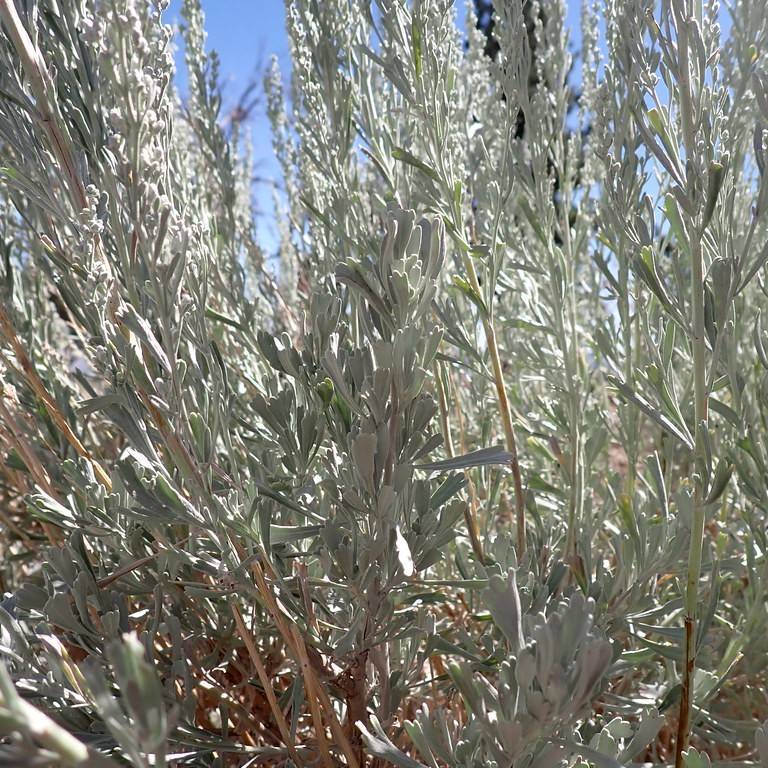
Big Sagebrush
Artemisia tridentata
Overview
Big sagebrush is a foundational species of the sagebrush steppe, one of North America’s most threatened ecosystems, providing critical habitat for species like the greater sage-grouse, pronghorn, and numerous native pollinators. Its distinctive silvery-gray foliage emits a sharp, camphor-like scent, especially after rain, and it develops a deep, extensive root system to access scarce moisture in arid soils. Individual plants can live for over 100 years in undisturbed areas, though they are highly vulnerable to wildfire, urban development, and invasive grass species.
Care Guide
Watering
Big sagebrush is extremely drought-tolerant once established, requiring only occasional deep watering during prolonged, extreme dry spells; overwatering is the most common cause of decline, as it leads to root rot. Newly planted specimens need light, regular watering for the first 1–2 growing seasons to encourage root establishment, but should be allowed to dry out completely between waterings. Avoid watering in late fall or winter, as wet cold soil can kill the plant.
Light
This shrub requires full, direct sunlight for at least 6 hours per day to thrive, and will not grow well in partial or full shade, becoming leggy and susceptible to disease if light is insufficient. It is adapted to the intense, unobstructed sunlight of western North American high deserts and plains, and tolerates high UV exposure without damage.
Soil
Big sagebrush requires well-drained, gravelly, sandy, or loamy soil with a neutral to slightly alkaline pH, and will not survive in heavy, waterlogged clay soils. It is adapted to low-nutrient, poor quality soils common in arid regions, and does not need amended or enriched soil to grow well. Good drainage is the most critical soil requirement, as even short periods of standing water can kill the plant.
Fertilizer
Big sagebrush does not require regular fertilization, as it is adapted to low-nutrient dryland soils; excess nitrogen from fertilizers can encourage rapid, weak growth that is more susceptible to drought stress and pest damage. If grown in extremely poor soil, a single application of a low-nitrogen, slow-release fertilizer in early spring may be used sparingly, but is generally unnecessary for established plants. Avoid high-nitrogen fertilizers entirely, as they can alter the plant’s natural terpene production and reduce its hardiness.
Temperature
Big sagebrush is adapted to a wide range of temperatures, tolerating extreme summer heat above 100°F (38°C) and harsh winter lows down to -40°F (-40°C) when fully dormant. It is hardy in USDA zones 4 through 9, and requires a period of cold winter dormancy to thrive, making it unsuitable for tropical or warm, frost-free climates. Young plants may need light protection from extreme cold snaps in their first 1–2 years, but established specimens are highly cold-tolerant.
Pruning
Pruning is rarely needed for big sagebrush, as it naturally develops a rounded, uniform growth habit; only dead, damaged, or diseased branches should be removed as needed, ideally in late winter before new growth emerges. Avoid heavy pruning or cutting back into old, woody stems, as the plant has limited ability to resprout from mature wood, and over-pruning can kill the specimen. If shaping is required, only light trimming of new growth should be done in early spring.
Propagation
Big sagebrush is most commonly propagated from seed, which requires a 30–90 day period of cold stratification to break dormancy, and should be sown on the soil surface in fall or early spring, as it needs light to germinate. It can also be propagated from semi-hardwood cuttings taken in late summer, though cuttings have a lower success rate and require consistent moisture and well-drained rooting medium to develop roots. Wild-collected seed is often more viable than commercially sourced seed, as it is adapted to local climate conditions.
Humidity
Big sagebrush thrives in low to moderate humidity levels between 10% and 40%, typical of its native arid and semi-arid habitat, and is highly intolerant of prolonged high humidity, which can lead to foliar fungal diseases. It will not grow well in humid coastal or tropical regions, where consistent moisture in the air can weaken the plant and make it susceptible to rot. Good air circulation is critical to prevent disease in areas with slightly higher humidity.
Repotting
Big sagebrush is rarely grown in containers, as it develops a deep, extensive taproot that requires ample space to grow, and container-grown specimens rarely reach their full size or lifespan. If grown in a pot, it should be planted in a deep, well-drained container with a cactus or succulent potting mix, and repotted only when roots are visibly growing out of the drainage holes, ideally in early spring before new growth starts. Once the plant reaches a mature size, repotting can be replaced with annual top-dressing of fresh soil to add minimal nutrients without disturbing the root system.
Uses & Symbolism
Ecologically, big sagebrush is a critical habitat and food source for a wide range of native wildlife, including sage-grouse, mule deer, and native bees, and it helps prevent soil erosion in arid landscapes. Historically, Indigenous peoples of western North America used its leaves for medicinal purposes to treat colds, headaches, and digestive issues, and as a smudge herb for ceremonial purification. It is also used in xeriscaping and native plant landscaping in arid regions, as it requires no supplemental irrigation once established and provides year-round visual interest.
Diseases & Pests
Big sagebrush is relatively pest and disease resistant when grown in its native habitat, but overwatering or high humidity can lead to root rot and powdery mildew, the most common issues affecting cultivated specimens. It is susceptible to infestations of sagebrush aphids, spider mites, and sagebrush leaf beetles, though these rarely cause serious damage to healthy, established plants. It is also highly vulnerable to mortality from wildfire, as its foliage contains high levels of flammable terpenes, and it cannot resprout from the root crown after burning, requiring seed dispersal from unburned areas to recolonize burned sites.
Related plants
Other plants you might like if you grow Big Sagebrush.