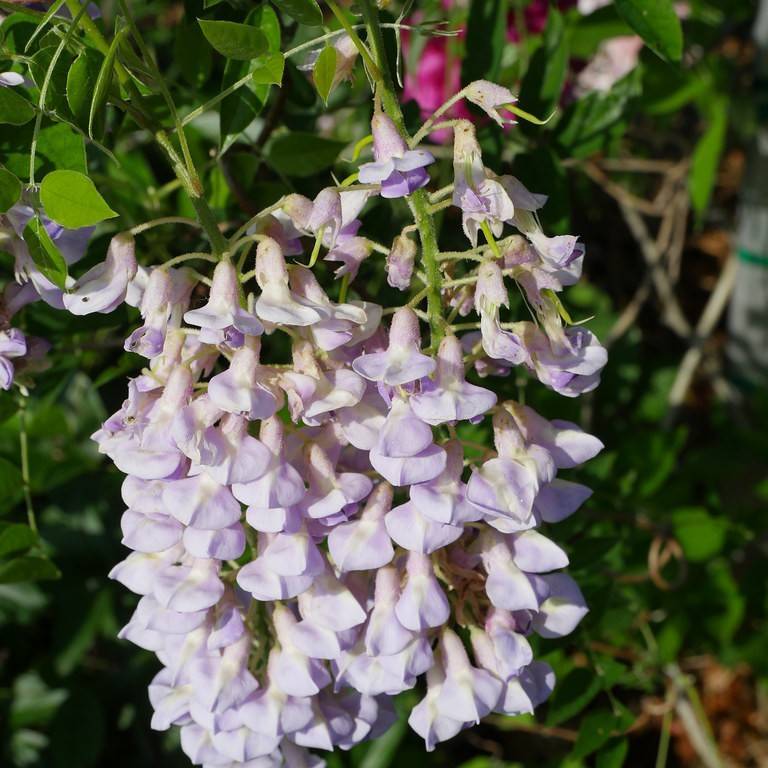
American Wisteria
Wisteria frutescens
Overview
American wisteria is a less aggressive alternative to its invasive Asian counterparts, Wisteria sinensis and Wisteria floribunda, making it a popular choice for North American gardens. It bears drooping, 4-6 inch long racemes of pea-like, sweetly fragrant flowers in shades of lilac-purple, pale blue, or white, which emerge after the plant has leafed out in late spring. Its dark green, pinnately compound leaves turn pale yellow in autumn, and its smooth, twining stems can be trained on arbors, trellises, fences, or even as a small standard tree.
Care Guide
Watering
Water young plants regularly to keep the soil consistently moist but not waterlogged, aiming for 1 inch of water per week during the growing season. Established plants are moderately drought-tolerant, but supplemental watering during prolonged dry spells will support healthy blooming and prevent stress. Avoid overwatering, as soggy soil can lead to root rot and reduce flowering.
Light
Plant American wisteria in full sun, defined as at least 6 hours of direct, unfiltered sunlight per day, to maximize bloom production. It can tolerate partial shade, but too much shade will result in sparse flowering and lanky, weak growth. For indoor or patio container specimens, place in a south-facing window or under full-spectrum grow lights to meet light requirements.
Soil
This vine adapts to a wide range of soil types, including clay, loam, and sandy soils, as long as the site has good drainage. It prefers a slightly acidic to neutral soil pH between 6.0 and 7.0, and will struggle in overly alkaline soils that lock up essential nutrients like iron. Amend heavy, compacted soils with compost or well-rotted manure before planting to improve aeration and drainage.
Fertilizer
Fertilize sparingly, as excess nitrogen will promote lush foliage growth at the expense of flowers. Apply a balanced, slow-release 10-10-10 fertilizer once per year in early spring, just before new growth emerges, or use a phosphorus-rich fertilizer specifically formulated for flowering plants to support bloom development. Avoid fertilizing after mid-summer, as this can stimulate tender new growth that is vulnerable to frost damage.
Temperature
American wisteria is cold-hardy in USDA zones 5 through 9, tolerating winter temperatures as low as -20°F (-29°C) once established. It requires a period of winter chilling, roughly 300-500 hours below 45°F (7°C), to break dormancy and produce blooms the following spring. Hot summer temperatures above 90°F (32°C) are well-tolerated as long as the plant receives adequate moisture.
Pruning
Prune twice per year to encourage flowering and control growth: once in late winter, when the plant is dormant, to remove dead, damaged, or crossing branches and cut back side shoots to 2-3 buds, and once in mid-summer, 2-3 months after flowering, to trim back unruly new growth and shape the vine. Regular pruning is essential, as unpruned plants can become overgrown and may take several years to bloom if left to sprawl. To train as a standard tree, select a single main stem, stake it upright, and remove all lower side shoots until the desired height is reached.
Propagation
The most reliable method for home gardeners is softwood cuttings taken in late spring or early summer, when new growth is semi-mature: cut 4-6 inch long stem tips, remove the lower leaves, dip the cut end in rooting hormone, and plant in a moist, well-draining potting mix, keeping the cuttings warm and humid until roots form in 4-6 weeks. It can also be propagated from seed, but seed-grown plants can take 10-15 years to bloom, and may not retain the exact flower color or growth habit of the parent plant. Grafting is used commercially to produce named cultivars that bloom reliably within 2-3 years of planting.
Humidity
American wisteria thrives in average ambient humidity levels between 40% and 60%, which are typical of its native southeastern U.S. habitat. It tolerates both drier inland conditions and higher humidity in coastal regions, as long as there is good air circulation around the foliage to prevent fungal diseases. Misting is not necessary for established plants, and excessive humidity without airflow can lead to powdery mildew or leaf spot.
Repotting
Container-grown American wisteria should be repotted every 2-3 years in late winter, before new growth begins, using a slightly larger container with drainage holes and a well-draining, loamy potting mix. Root-bound plants will bloom more reliably, so avoid overpotting and only increase the container size by 1-2 inches each time. Prune up to one-third of the root ball during repotting to control growth and encourage the development of fine, feeder roots that support flowering.
Uses & Symbolism
American wisteria is primarily grown as an ornamental vine for covering arbors, pergolas, trellises, and fences, adding vertical interest and a sweet, floral fragrance to spring gardens. Its dense foliage provides summer shade when trained over overhead structures, and it supports native pollinators including bumblebees, hummingbirds, and butterfly species that feed on its nectar. It is also a popular choice for native plant and wildlife gardens, as it is a larval host for the silver-spotted skipper and long-tailed skipper butterflies.
Diseases & Pests
The most common pests of American wisteria include aphids, scale insects, and Japanese beetles, which feed on foliage and young shoots; these can be controlled with insecticidal soap, neem oil, or hand-picking for small infestations. Fungal diseases such as powdery mildew, leaf spot, and crown rot can occur in poorly drained soils or areas with high humidity and poor air circulation, and can be prevented by planting in full sun, spacing plants to allow airflow, and avoiding overhead watering. Root rot is the most serious disease, typically caused by overwatering or planting in heavy, waterlogged soil, and can be fatal if not addressed quickly by improving drainage or moving the plant to a drier site.
Related plants
Other plants you might like if you grow American Wisteria.