Japanese Honeysuckle
Lonicera japonica
Overview
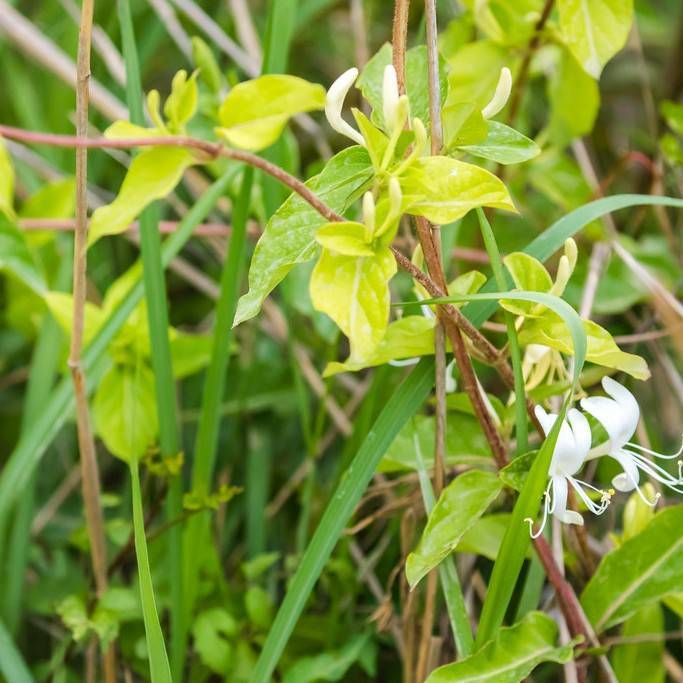
Japanese Honeysuckle is a twining woody vine valued for its intensely sweet, heady fragrance that peaks in late spring and early summer. It produces pairs of tubular, two-lipped flowers that open white and fade to pale yellow, followed by small, glossy black berries in fall. Though widely planted for its ornamental appeal and ability to cover fences or arbors quickly, it is classified as an invasive species in much of North America, Australia, and New Zealand, where it outcompetes native vegetation by smothering plants and blocking sunlight.
Care Guide
Watering
Water newly planted Japanese Honeysuckle regularly to keep the soil consistently moist but not waterlogged for the first growing season, until roots are established. Once established, it is highly drought-tolerant, requiring supplemental watering only during extended periods of dry, hot weather. Overwatering can lead to root rot, so allow the top 1 to 2 inches of soil to dry out between waterings for mature plants.
Light
This vine thrives in full sun, which encourages the most abundant flowering and strongest growth, though it will tolerate partial shade. In shadier locations, flowering will be reduced, and the vine may grow more sparsely, with longer gaps between leaf nodes. For indoor or container-grown specimens, place in a south or west-facing window that receives at least 6 hours of direct sunlight daily.
Soil
Japanese Honeysuckle is adaptable to a wide range of soil types, including sandy, loam, and clay soils, as long as they drain well. It prefers a slightly acidic to neutral soil pH between 5.5 and 7.5, but will tolerate mildly alkaline conditions as well. Amending heavy or poor soil with organic matter such as compost will improve drainage and nutrient availability to support healthier growth.
Fertilizer
Feed established plants once per year in early spring, before new growth emerges, with a balanced, slow-release 10-10-10 fertilizer formulated for woody ornamental plants. Avoid over-fertilizing, as excess nitrogen will promote lush leafy growth at the expense of flower production. Container-grown plants benefit from a diluted liquid fertilizer applied every 4 to 6 weeks during the active growing season from spring to late summer.
Temperature
It is hardy in USDA zones 4 through 9, tolerating winter temperatures as low as -30°F (-34°C) when established. It prefers moderate summer temperatures between 65°F and 85°F (18°C to 29°C), but can tolerate short periods of heat above 95°F (35°C) if provided with adequate moisture. In regions with extreme winter cold, apply a 2 to 3 inch layer of mulch around the base of the vine in late fall to protect the root system from freeze-thaw cycles.
Pruning
Prune Japanese Honeysuckle annually in late winter or early spring, before new growth begins, to control its spread and remove dead, damaged, or diseased stems. To prevent it from becoming invasive, cut back overgrown vines by up to one-third of their total length each year, and remove any stray stems that are spreading into natural areas or adjacent plantings. After flowering, you can deadhead spent blooms to encourage a second, smaller flush of flowers later in the season, though this is not required for plant health.
Propagation
The easiest method of propagation is through semi-hardwood cuttings taken in mid to late summer, from healthy, current-year growth that is just starting to woody at the base. Remove leaves from the lower half of the 4 to 6 inch cutting, dip the cut end in rooting hormone, and plant in a moist, well-draining potting mix, keeping it warm and humid until roots form in 4 to 6 weeks. It can also be propagated by layering, where a low-growing stem is pinned to the soil surface and left to root while still attached to the parent plant, then separated and transplanted once roots are established.
Humidity
Japanese Honeysuckle tolerates a wide range of humidity levels, thriving in average outdoor humidity between 40% and 70% found in most temperate regions. It does not require additional humidity when grown outdoors, even in drier climates, as long as it receives adequate watering. Indoor container-grown specimens will benefit from occasional misting during very dry winter months, when indoor humidity levels drop below 30%, to prevent leaf browning at the edges.
Repotting
Container-grown Japanese Honeysuckle should be repotted every 2 to 3 years in early spring, before new growth starts, to refresh the soil and prevent root binding. Choose a pot that is 2 to 3 inches larger in diameter than the current container, with ample drainage holes to prevent waterlogging. When repotting, gently loosen tangled roots and trim any excessively long or rotted root sections before planting in fresh, well-draining potting mix amended with compost.
Uses & Symbolism
Japanese Honeysuckle is widely cultivated as an ornamental vine for covering arbors, fences, trellises, and walls, valued for its prolific, fragrant flowers that attract pollinators including bees, butterflies, and hummingbirds. In traditional East Asian medicine, the flowers and stems are used to make teas, tinctures, and topical treatments for colds, fevers, inflammation, and skin conditions, though internal consumption should be done under professional guidance to avoid toxicity. It is also occasionally planted for erosion control on slopes, though its invasive potential means this use is not recommended in regions where it is not native.
Diseases & Pests
Japanese Honeysuckle is relatively pest and disease resistant, but may be susceptible to powdery mildew, a fungal disease that causes a white, powdery coating on leaves, particularly in humid conditions with poor air circulation. Aphids, scale insects, and spider mites may occasionally infest new growth, sucking sap from leaves and causing yellowing or stunted growth, which can be treated with insecticidal soap or neem oil. Root rot may occur in poorly draining soil or if the plant is overwatered, leading to wilting, yellowing leaves, and eventual plant death if the issue is not corrected.
Related plants
Other plants you might like if you grow Japanese Honeysuckle.