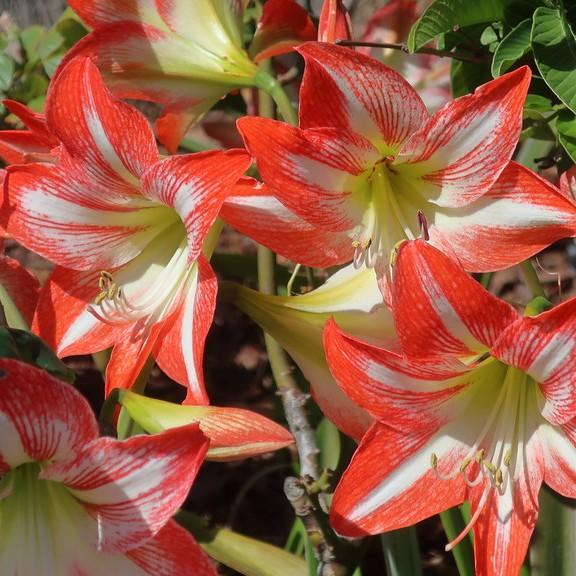
Amaryllis
Hippeastrum spp.
Overview
Amaryllis, often sold as potted bulbs during the winter holiday season, produces striking, large trumpet-shaped flowers in shades of red, pink, white, orange, and bicolored patterns atop thick, upright stems. Though often treated as a disposable decorative plant after blooming, it can be kept as a long-lived perennial that reblooms annually with proper care. The species commonly cultivated belong to the Hippeastrum genus, distinct from the true Amaryllis genus native to South Africa, though the common name is widely used interchangeably for the commercially popular varieties.
Care Guide
Watering
Water amaryllis sparingly when first planting a dormant bulb, only increasing watering once new growth emerges to avoid bulb rot. Keep soil consistently moist but not waterlogged during active growth and blooming, allowing the top 1 inch of soil to dry out between waterings, and reduce watering gradually once foliage begins to die back in late summer.
Light
Place newly planted dormant bulbs in bright, indirect light to encourage strong stem and leaf development. Once blooms open, move the plant to slightly lower indirect light to extend the flowering period, and provide full sun for the foliage during the post-bloom growing season to support bulb energy storage for the next year's flowers.
Soil
Amaryllis thrives in a well-draining, loose potting mix rich in organic matter, such as a blend of peat moss, perlite, and compost. The soil pH should be slightly acidic to neutral, between 6.0 and 7.0, to support optimal nutrient uptake, and heavy, water-retentive soils should be avoided to prevent bulb rot.
Fertilizer
Apply a balanced, water-soluble houseplant fertilizer diluted to half strength every 2 to 3 weeks during active growth, starting once new leaves reach 2 to 3 inches in height. Discontinue fertilizing once the foliage begins to yellow and die back in late summer, as the bulb enters dormancy and does not require extra nutrients during this resting period.
Temperature
Amaryllis prefers temperatures between 65-75°F (18-24°C) during active growth and blooming, with cooler nighttime temperatures around 60°F (15°C) helping to extend flower life. After blooming, keep the plant in similar temperatures during the foliage growing phase, then provide a cool, dark dormancy period of 8-10 weeks at 50-55°F (10-13°C) to trigger reblooming.
Pruning
Cut spent flower stems down to 1 to 2 inches above the bulb once blooms fade, being careful not to damage the emerging foliage, which needs to remain intact to photosynthesize and replenish the bulb's energy reserves. Once foliage turns yellow and dies back naturally in late summer, trim all leaves down to the top of the bulb before placing it in dormancy.
Propagation
Amaryllis is most commonly propagated by separating small offset bulbs that grow around the base of a mature parent bulb during repotting, planting each offset in its own container and growing it for 2-3 years until it is large enough to bloom. It can also be grown from seed, though seed-grown plants take 3-5 years to reach flowering size and may not retain the characteristics of the parent cultivar.
Humidity
Amaryllis adapts well to average indoor humidity levels between 40-50% during active growth and blooming, requiring no extra misting or humidity adjustments in most home environments. Extremely dry air below 30% may cause leaf tip browning, which can be mitigated by placing the pot on a pebble tray filled with water, avoiding direct contact between the pot base and standing water.
Repotting
Repot amaryllis every 2 to 3 years after the dormancy period ends, choosing a pot that is only 1 to 2 inches wider in diameter than the bulb, as tight root space encourages better blooming. When repotting, leave the top one-third to one-half of the bulb exposed above the soil line, as planting the bulb too deeply can inhibit flowering and increase rot risk.
Uses & Symbolism
Amaryllis is most widely used as a decorative indoor potted plant for winter and holiday displays, prized for its showy, long-lasting blooms that add vibrant color to indoor spaces. It is also grown as a garden perennial in frost-free USDA zones 9-11, where it is planted in borders or as container specimens on patios, and cut stems are popular in floral arrangements for their dramatic size and bold hues.
Diseases & Pests
The most common issue affecting amaryllis is bulb rot, caused by overwatering, poorly draining soil, or planting the bulb too deeply, which presents as soft, mushy bulb tissue and yellowing, wilting foliage. Common pests include spider mites, mealybugs, and aphids, which feed on foliage and stems, and can be controlled with insecticidal soap or neem oil applications, while fungal leaf spot may occur in overly humid conditions, requiring removal of affected foliage and improved air circulation.
Related plants
Other plants you might like if you grow Amaryllis.