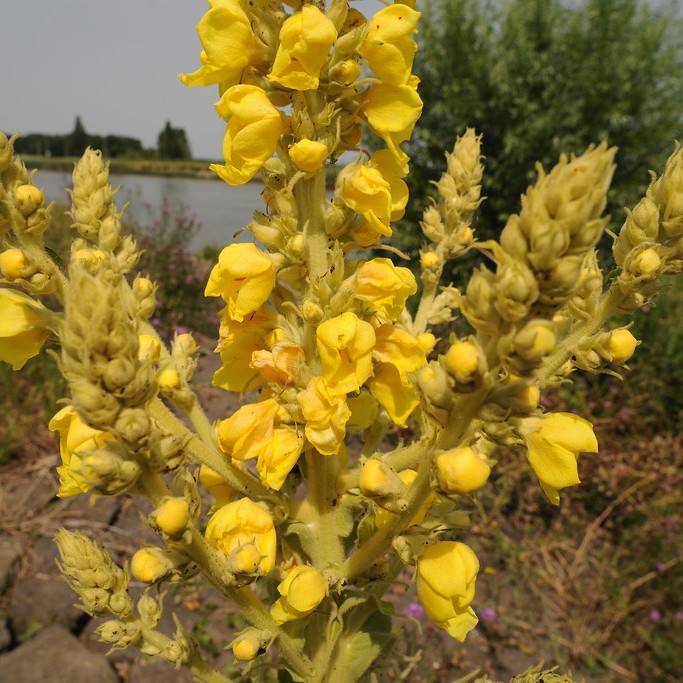
Common Mullein
Verbascum thapsus
Overview
In its first year, common mullein forms a low rosette of soft, fuzzy, silvery-green leaves up to 12 inches long. The second year it sends up a tall, unbranched flower spike covered in small, bright yellow, five-petaled blooms that open sequentially from the bottom up. It is highly adaptable, often colonizing roadsides, fields, and disturbed areas where other plants struggle to establish.
Care Guide
Watering
Common mullein is extremely drought tolerant, requiring only occasional watering during prolonged dry spells once established. Overwatering or saturated soil will quickly cause root rot, so it is best to err on the side of underwatering. Newly planted seedlings need regular, light moisture until they develop a strong root system, typically 2-3 weeks after planting.
Light
This plant requires full sun, a minimum of 6 hours of direct, unfiltered sunlight daily to thrive and produce a robust flower spike. It will not grow well in partial shade, developing leggy growth and reduced flowering if light levels are too low. For indoor starts, place seedlings under bright grow lights to prevent stretching before transplanting outdoors.
Soil
Common mullein prefers dry, sandy or gravelly, well-drained soil with a neutral to slightly alkaline pH. It tolerates poor, low-nutrient soils that many other plants cannot survive in, including rocky and compacted sites. Heavy clay soils that hold moisture are unsuitable, as they lead to fatal root rot even with minimal watering.
Fertilizer
Fertilization is rarely necessary for common mullein, as it thrives in low-nutient conditions. Excess nitrogen will cause overly lush leaf growth and a weak, floppy flower spike that requires staking. If growing in extremely poor soil, a single application of balanced, slow-release fertilizer in early spring of the second year is sufficient.
Temperature
It is cold hardy in USDA zones 3 through 9, tolerating winter temperatures as low as -40°F (-40°C) during its first-year rosette stage. It tolerates high summer temperatures up to 100°F (38°C) with no adverse effects, as long as soil drainage is good. Frost will kill the flower spike and mature plant at the end of its second growing season, as it completes its lifecycle after seeding.
Pruning
Pruning is minimal for common mullein: spent flower spikes can be cut back to the base after blooming to prevent unwanted self-seeding, as it can become invasive in some regions. First-year rosettes require no pruning, though damaged or yellowed lower leaves can be removed to improve appearance if desired. If you wish to encourage more blooms, cut the main spike by a third when it first emerges, which will prompt branching and multiple smaller flower spikes.
Propagation
Common mullein is almost exclusively propagated from seed, which can be sown directly outdoors in fall or early spring, as the seeds require a period of cold stratification to germinate. Seeds need light to germinate, so press them lightly into the soil surface rather than covering them, and keep the area moist until seedlings emerge in 10-14 days. It self-seeds readily, so volunteers can be transplanted in early spring while still small, as it develops a deep taproot that does not tolerate disturbance once mature.
Humidity
Common mullein tolerates a wide range of humidity levels, from dry arid climates to moderately humid temperate regions. High humidity combined with wet soil is the primary risk, as it can lead to fungal leaf spots and root rot. Good air circulation around the plant helps prevent fungal issues in more humid environments.
Repotting
Repotting is rarely required, as common mullein is almost always grown outdoors directly in the ground. If growing in a container, use a deep pot at least 12 inches deep to accommodate its long taproot, and avoid repotting once it enters its second year of growth, as disturbance to the taproot will often kill the plant. Container-grown specimens should be planted into fresh, well-drained potting mix at the start of their first growing season, and do not need repotting before they complete their two-year lifecycle.
Uses & Symbolism
Historically, common mullein has been used in herbal medicine to treat respiratory issues, earaches, and skin irritations, with its leaves and flowers often brewed into teas or infused into oils. The soft, fuzzy leaves were historically used as emergency toilet paper, wadding for fires, or insulation in clothing. It is also grown as an ornamental in cottage or wildflower gardens, providing vertical interest and attracting pollinators like bees and hummingbirds.
Diseases & Pests
Common mullein is largely pest and disease resistant, with the most common issue being root rot caused by overwatering or poorly draining soil. Fungal leaf spots may occur in humid, poorly ventilated conditions, though these are rarely fatal and can be managed by removing affected leaves and improving air flow. Rarely, it may be affected by aphids or spider mites, which can be treated with insecticidal soap or a strong jet of water to dislodge the pests.
Related plants
Other plants you might like if you grow Common Mullein.