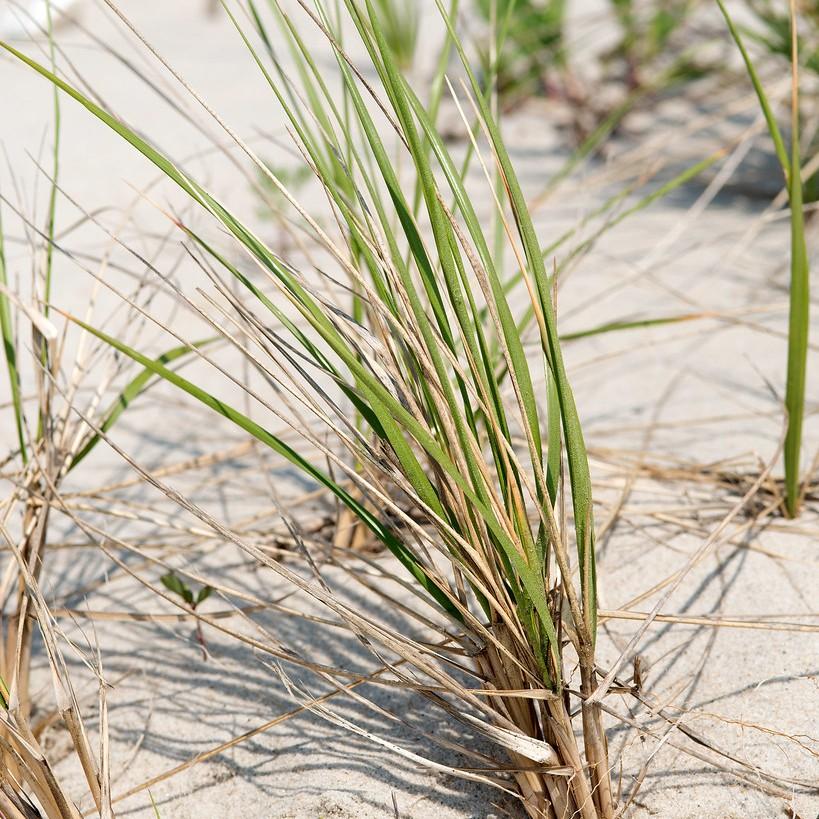
American Beachgrass
Ammophila breviligulata
Overview
American Beachgrass is a clumping, cool-season grass that thrives in harsh coastal conditions, including salt spray, strong winds, and regular sand burial. Its extensive, deep rhizome system spreads horizontally, binding sand particles together to build and stabilize dunes, making it a critical species for coastal ecosystem resilience. It produces slender, upright green foliage and sparse, pale tan flower spikes in mid-summer, which mature into seed heads by late fall. While naturally adapted to coastal environments, it is also planted inland for dune stabilization around large lakes and sandy, disturbed sites.
Care Guide
Watering
American Beachgrass is highly drought-tolerant once established, requiring only natural rainfall in its native range; newly planted specimens need occasional watering for the first 2-3 months to encourage root development, but overwatering will lead to root rot. It tolerates occasional submersion by high tides but does not thrive in consistently waterlogged soils.
Light
This grass requires full, direct sun for optimal growth, tolerating no less than 6 hours of unfiltered sunlight daily. It will fail to spread or become sparse if planted in shaded locations, as it is adapted to the unobstructed light of open coastal dunes.
Soil
It grows best in well-drained, sandy, low-nutrient soils, with a pH range of 5.5 to 8.0, tolerating high salt content from coastal spray and tidal exposure. Heavy, clay, or organically rich soils will restrict rhizome spread and increase risk of root decay, so amending planting sites with sand to improve drainage is recommended for non-native locations.
Fertilizer
American Beachgrass is adapted to low-nutrient sandy soils, so it rarely requires fertilization; excess nitrogen will encourage overly lush foliage at the expense of rhizome development, reducing its dune-stabilizing ability. If planted in extremely depleted sand, a single light application of low-nitrogen, slow-release fertilizer in early spring can be applied sparingly.
Temperature
It is cold-hardy in USDA zones 3 to 8, tolerating winter temperatures as low as -40°F (-40°C) and extreme summer heat up to 100°F (38°C) when grown in its preferred sandy, well-drained sites. It is not suited to tropical or subtropical climates, as prolonged high humidity and warm winter temperatures will promote fungal disease.
Pruning
Pruning is rarely required; dead foliage can be cut back to 4-6 inches above the soil line in late winter or early spring before new growth emerges to keep stands neat. Avoid heavy pruning during the active growing season, as this will reduce the plant’s ability to photosynthesize and spread rhizomes.
Propagation
It is most commonly propagated via rhizome cuttings, taken from mature stands in late winter or early spring, planted 6-8 inches deep in sandy soil, spaced 12-18 inches apart for erosion control projects. Propagation from seed is possible but less reliable, as seed germination rates are low and seedlings grow much slower than rhizome transplants.
Humidity
American Beachgrass tolerates high coastal humidity and salt spray naturally, as its foliage has a waxy coating that repels salt and excess moisture. Inland plantings tolerate average ambient humidity, but prolonged high humidity combined with poor air circulation can increase risk of foliar fungal diseases.
Repotting
As a landscape and dune-stabilization plant, it is almost never grown in containers, so repotting is not required. If grown temporarily in pots for transplant projects, plant out to permanent sandy sites as soon as rhizomes begin to emerge from the drainage holes to avoid stunting growth.
Uses & Symbolism
American Beachgrass is the primary species used for coastal dune restoration and shoreline erosion control across the Atlantic coast and Great Lakes region, as its rhizome network stabilizes shifting sand and reduces storm surge damage to coastal infrastructure. It provides critical habitat for coastal shorebirds, including piping plovers and terns, which nest in the dune systems it forms, and its foliage serves as a food source for native grasshoppers and other coastal invertebrates. It is occasionally planted in xeriscaped, sandy residential landscapes as a low-maintenance, drought-tolerant ornamental grass.
Diseases & Pests
The most common issues for American Beachgrass are foliar fungal diseases including rust and leaf spot, which occur in prolonged high humidity with poor air circulation, particularly in stands that are overwatered or planted in non-sandy, poorly drained soils. Common pests include aphids and grasshoppers, which may feed on foliage, but damage is rarely severe enough to require treatment in natural stands. Root rot is a major risk in heavy, waterlogged soils, and can kill entire stands if drainage is not improved.
Related plants
Other plants you might like if you grow American Beachgrass.