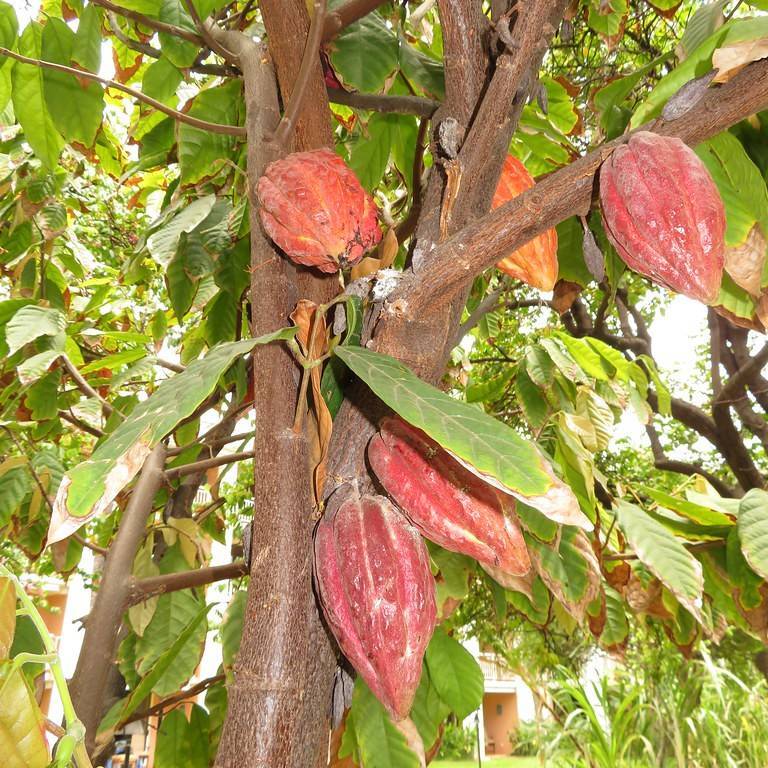
Cacao
Theobroma cacao
Overview
Cacao is a broad-leaved evergreen tree native to the humid understory of Neotropical rainforests, cultivated commercially across equatorial regions worldwide. It bears large, colorful pod fruits directly on its trunk and older branches (a trait called cauliflory), each holding 20 to 60 seeds known as cocoa beans. The tree has been cultivated for over 3,000 years by Indigenous Mesoamerican cultures, who valued its beans for ceremonial, culinary, and medicinal uses.
Care Guide
Watering
Cacao requires consistent, even moisture, with soil kept lightly damp but never waterlogged to prevent root rot; reduce watering slightly during cooler, drier months if grown in non-native climates. Avoid overhead watering to minimize fungal disease risk, directing water directly to the root zone instead.
Light
As an understory rainforest tree, cacao thrives in bright, indirect light or partial shade, with protection from intense, direct midday sun that can scorch its large, thin leaves. Young saplings require heavier shade, while mature trees can tolerate small amounts of gentle morning sun.
Soil
Cacao prefers rich, well-draining loamy soil with a high organic matter content and a slightly acidic to neutral pH between 6.0 and 7.0. Heavy clay soils that retain excess moisture are unsuitable, so amend with compost or leaf mold to improve structure and nutrient content before planting.
Fertilizer
Feed cacao trees with a balanced, slow-release fertilizer high in nitrogen, phosphorus, and potassium every 2 to 3 months during the active growing season to support foliage and fruit development. Supplement with organic matter such as composted manure or cocoa shell mulch twice a year to boost soil fertility naturally.
Temperature
Cacao requires consistently warm temperatures between 65–90°F (18–32°C) to thrive, with no exposure to temperatures below 60°F (15°C) which can cause leaf drop and stunted growth. It is extremely frost-sensitive, so trees grown in temperate climates must be kept indoors or in heated greenhouses during cool seasons.
Pruning
Prune cacao trees annually during the dormant period to remove dead, diseased, or crossing branches, improving air circulation and light penetration to reduce fungal disease risk. Limit the height of cultivated trees to 15–20 feet to simplify harvest of the trunk-growing pods, and remove any suckers growing from the base of the trunk to direct energy to fruit production.
Propagation
Cacao is most commonly propagated from fresh, viable seeds planted within 1–2 weeks of removal from the pod, as seeds lose viability quickly when dried. It can also be propagated via stem cuttings taken from healthy, mature branches, which produce trees that bear fruit faster than seed-grown specimens and retain the parent plant’s desirable traits.
Humidity
Cacao thrives in high humidity levels between 70–90%, mimicking its native rainforest habitat; low humidity can cause leaf browning, reduced flowering, and poor fruit set. Grow indoor or greenhouse specimens near a humidifier or on a pebble tray filled with water to maintain adequate ambient moisture.
Repotting
Repot young cacao saplings every 12 to 18 months into a slightly larger container with fresh, nutrient-rich potting mix to support fast early growth. Mature potted cacao trees only need repotting every 3 to 4 years, as they prefer being slightly root-bound to encourage flowering and fruit production instead of excessive vegetative growth.
Uses & Symbolism
Cacao beans are the primary raw material for chocolate, cocoa powder, and cocoa butter, used globally in confectionery, baked goods, beverages, and cosmetic products. Historically, cacao has been used in traditional medicine to treat digestive issues, fatigue, and heart conditions, and its high antioxidant content has made it a popular functional food in modern wellness practices. In its native range, cacao pods are sometimes used for animal feed, and the tree’s wood is harvested for small-scale construction and craft projects.
Diseases & Pests
Cacao is highly susceptible to fungal diseases including black pod rot, which causes pod browning and decay, and frosty pod rot, which covers pods in a white powdery coating and destroys seeds. Common pests include cocoa pod borers, aphids, and mealybugs, which feed on foliage and pods, reducing yields and spreading viral pathogens such as cacao swollen shoot virus.
Related plants
Other plants you might like if you grow Cacao.