Arum Italicum: Complete Care, Identification, and Growing Guide
Learn how to grow, identify, and care for Arum italicum (Italian arum), plus key details on its toxicity, invasiveness, and popular cultivars.
Arum Italicum: Complete Care, Identification, and Growing Guide
Arum italicum, or Italian arum, is a herbaceous perennial aroid grown for its marbled winter foliage, pale spring flowers, and bright summer berries. It requires partial shade and well-drained soil, but is toxic to humans and pets, and invasive in some regions, so identification and care precautions are critical.
What Is Arum Italicum? Key Identification Traits
Arum italicum, commonly called Italian arum, is a herbaceous perennial in the Araceae family. It grows 12–18 inches tall, with arrow-shaped, glossy green leaves often marbled with white or cream veins, and produces pale green spathe flowers in spring followed by clusters of bright red-orange berries in late summer.
Core physical characteristics: foliage, flowers, berries
- Foliage: Arrow-shaped, 6–12 inches long, with a glossy surface and distinct white or cream veining on most specimens. Leaves emerge in early fall and persist through winter in mild climates.
- Flowers: Small, clustered blooms enclosed in a 4–6 inch pale green, hood-like spathe, typical of aroid species. Blooms appear in mid-spring and last 2–3 weeks before fading.
- Berries: Dense, upright clusters of 10–30 round, bright red-orange berries that develop in late summer, after the foliage has died back for dormancy.
Seasonal growth cycle: winter foliage, spring blooms, summer dormancy
Unlike most garden perennials, Arum italicum follows a reverse seasonal growth schedule. It breaks dormancy in early fall, produces foliage that remains evergreen through cool winter months, blooms in spring, and dies back completely to underground tubers in mid-to-late summer when temperatures rise. No visible growth appears during the 2–3 month dormancy period.
How to use Sproutly to distinguish Arum italicum from lookalike aroids
Many aroid species share similar arrow-shaped foliage, making visual identification challenging for beginners. Upload a photo of your unknown plant to the Sproutly app to confirm if it is Arum italicum, and receive instant details on its toxicity, invasiveness status in your region, and custom care recommendations. This is especially useful if you find volunteer plants growing wild, as it helps you avoid accidentally cultivating an invasive population.
Arum Italicum Taxonomy and Popular Cultivars
Arum italicum is part of the Arum genus, which includes over 25 species of flowering aroids native to Europe, North Africa, and western Asia. The most widely grown ornamental cultivar is Arum italicum subsp. italicum 'Marmoratum', prized for its heavily marbled foliage.
Official classification and subspecies variants
There are two recognized subspecies of Arum italicum: Arum italicum subsp. italicum, the most widespread type, and Arum italicum subsp. neglectum, which has less prominent leaf marbling and smaller flowers. Subspecies can cross-pollinate in garden settings, resulting in variable foliage patterns.
Key traits of 'Marmoratum' (the most common garden cultivar)
Arum italicum subsp. italicum 'Marmoratum' is the standard ornamental cultivar, distinguished by dense, bright white veining that covers most of the leaf surface, creating a dramatic marbled effect. It grows slightly larger than the wild species, reaching up to 18 inches tall at maturity, and produces more abundant berry clusters in summer.
How to tell Arum italicum apart from other arum species: dragon arum, water arum, green dragon
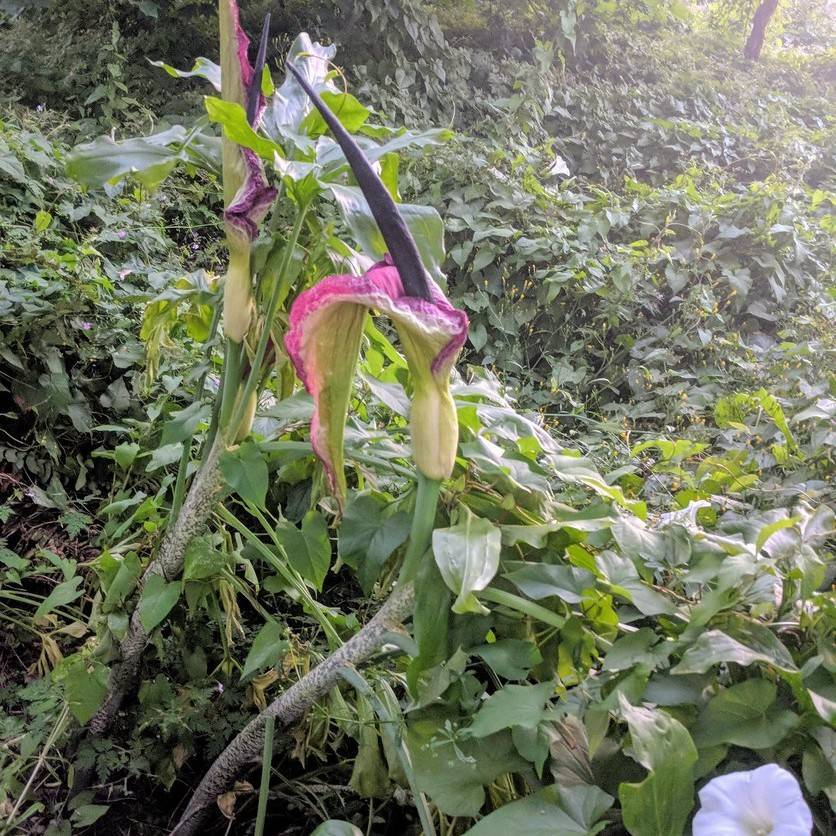
- dragon arum (Dracunculus vulgaris): Produces large, dark purple spathes with a distinct rotting odor when in bloom, and solid green leaves with no marbling.
- Water arum (Calla palustris): An aquatic species that grows only in wetland or bog conditions, with solid green heart-shaped leaves and white spathes.
- green dragon (Arisaema dracontium): A North American native with compound, divided leaves and a long, tapering green spathe, with no white leaf marbling.
Native Range and Natural Habitat of Arum Italicum
Arum italicum is native to the Mediterranean region, southern Europe, and parts of western Asia. It naturally grows in woodland edges, partial-shade grasslands, and rocky slopes, where it thrives in moist, well-drained soil and dappled sunlight.
Ideal native growing conditions
In its native range, Arum italicum grows in areas with mild, wet winters and dry, hot summers, in soil rich with organic leaf litter. It tolerates occasional drought during its summer dormancy, but requires consistent moisture during its winter active growth period.
Regions where it has been introduced outside its native range
Arum italicum has been introduced as an ornamental plant to North America, New Zealand, and parts of northern Europe. It has naturalized in many of these regions, particularly in areas with mild winter climates similar to its native Mediterranean habitat.
Preferred microclimates for outdoor planting
For outdoor cultivation, Arum italicum performs best in dappled shade under deciduous trees, where it receives full sun during the cool winter months when tree canopies are bare, and partial shade during the warm spring and fall. It tolerates a range of soil types, from sandy loam to clay, as long as drainage is good.
Is Arum Italicum Invasive? What to Know Before Planting
Arum italicum is classified as an invasive species in parts of the Pacific Northwest, mid-Atlantic United States, and New Zealand, where it spreads rapidly via self-seeding and underground tubers to outcompete native understory plants.
Regions where Arum italicum is listed as a noxious weed
As of 2024, Arum italicum is listed as a noxious or invasive weed in Washington, Oregon, California, Virginia, and Maryland in the U.S., as well as in the North Island of New Zealand. Check your local extension service’s invasive species list before planting, as regulations may change as new populations are recorded.
How it spreads: seed dispersal by birds and tuber fragmentation
Birds eat the bright red berries and disperse seeds over wide areas through their droppings, allowing the plant to colonize natural woodland areas far from original plantings. The plant also spreads via underground tubers, which can fragment when soil is tilled or dug, with each fragment capable of growing into a new plant.
Ecological impact on native woodland ecosystems
In invasive ranges, Arum italicum forms dense, monocultural mats of foliage that shade out native understory plants, including wildflowers and ferns, reducing food and habitat for native pollinators and small wildlife. It has no natural pests or diseases in introduced ranges, allowing populations to grow unchecked without active management.
Arum Italicum Toxicity: Safety for Humans, Pets, and Livestock
All parts of Arum italicum contain calcium oxalate crystals, which cause severe mouth and throat irritation, swelling, and gastrointestinal distress if ingested by humans, dogs, cats, or grazing livestock. The bright red berries are the most toxic part, and pose a particular risk to curious children and pets.
Symptoms of Arum italicum poisoning
Ingestion symptoms include immediate burning or stinging in the mouth, swelling of the lips, tongue, and throat, difficulty swallowing, nausea, vomiting, and diarrhea. In rare cases, severe throat swelling can cause breathing difficulties, requiring emergency medical care. Skin contact with sap may cause mild, temporary irritation in sensitive individuals.
Safety precautions for handling and planting
Wear waterproof gloves when handling Arum italicum, especially when digging up tubers or removing berry clusters, to avoid contact with sap. Keep plants out of reach of young children and pets, and avoid planting it in pastures or areas where grazing livestock have access.
Steps to take if ingestion is suspected
If a human or pet ingests any part of Arum italicum, contact a medical provider or veterinarian immediately. Do not induce vomiting unless directed to do so by a professional, as the calcium oxalate crystals can cause additional damage to the esophagus during regurgitation. Have the plant identification handy to share with care providers for faster treatment.
Traditional and Modern Uses of Arum Italicum
Despite its toxicity, Arum italicum has a long history of medicinal use in its native range, where processed root was once used to treat coughs, inflammation, and wounds. Today, it is primarily grown as an ornamental plant for its winter foliage and low-maintenance growth in shaded gardens.
Historical medicinal uses (note: do not consume raw or unprocessed plant material)
Traditional Mediterranean healers processed Arum italicum tubers by drying, roasting, and leaching them to remove toxic calcium oxalate crystals before using them to make poultices for wounds and internal remedies for respiratory issues. Raw or unprocessed plant material is never safe to consume, and modern medical authorities do not recommend any internal use of the plant.
Ornamental uses in shade gardens, rock gardens, and container plantings
As an ornamental, Arum italicum is valued for its evergreen winter foliage, which adds color to shaded garden beds when most other plants are dormant. It works well as a ground cover under deciduous trees, in shaded rock gardens, or in container plantings for patios and entryways. Its bright summer berry clusters also add visual interest after foliage dies back.
Eligibility for use in native plant alternatives (only in non-invasive regions)
In regions where Arum italicum is not listed as invasive, it can be a low-maintenance alternative to high-maintenance shade perennials that require frequent watering or fertilization. In invasive regions, avoid planting it entirely and opt for native alternatives that support local ecosystems.
Complete Arum Italicum Cultivation and Care Guide
Arum italicum grows best in partial shade, well-drained loamy soil with a pH of 6.0–7.5, and consistent moisture during its active winter growth period. It is hardy in USDA zones 5–9, and requires very little maintenance once established.
Planting instructions: tuber depth, spacing, and ideal planting time (late summer to early fall)
Plant Arum italicum tubers in late summer to early fall, before the plant breaks dormancy. Bury tubers 3–4 inches deep, with the pointed end facing up, and space them 6–8 inches apart to allow for mature foliage spread. Add 1–2 inches of leaf mulch over the planting area to retain moisture and add organic matter to the soil.
Watering schedule: 1 inch of water per week during active growth, no water during summer dormancy
Water newly planted tubers once a week for the first month to encourage root establishment. Once established, provide 1 inch of water per week during active growth (fall to spring) to keep soil consistently moist but not waterlogged. Stop watering entirely once foliage dies back in summer, as dry soil during dormancy prevents tuber rot.
Light requirements: partial shade (2–6 hours of direct sun per day), avoid full sun which scorches foliage
Arum italicum thrives in partial shade, with 2–6 hours of direct sun per day, preferably in the cool morning hours. Full midday sun will scorch foliage and cause it to die back prematurely, while full shade will result in sparse growth and fewer flowers and berries.
Fertilization: light application of balanced slow-release fertilizer in early fall, no additional feeding needed
Apply a light dose of balanced 10-10-10 slow-release fertilizer in early fall, just as new foliage begins to emerge. No additional fertilization is needed for the rest of the year, as excess nitrogen will cause lush foliage growth at the expense of flowers and berries, and may increase the risk of tuber rot.
Indoor growing tips for houseplant enthusiasts: potting mix, humidity requirements (50–70% relative humidity), and dormancy care
Arum italicum can be grown as a houseplant in regions where it is not hardy outdoors. Use a well-draining aroid potting mix with added perlite and orchid bark, and choose a pot with drainage holes to prevent overwatering. Maintain 50–70% relative humidity by placing the pot on a pebble tray filled with water, or using a small humidifier near the plant during dry winter months. When foliage dies back in summer, move the pot to a cool, shaded area of your home, stop watering entirely, and resume watering in early fall when new growth appears.
How to use Sproutly to set up custom care reminders for your Arum italicum plant
Add your Arum italicum to your Sproutly plant library to receive custom care reminders tailored to your local climate and growing conditions. The app will alert you when to water, fertilize, and check for berry clusters to remove, and will send notifications if your region adds Arum italicum to its invasive species list so you can adjust your planting plans accordingly.
How to Control and Remove Invasive Arum Italicum
Controlling established Arum italicum infestations requires removing all underground tubers, as even small fragments can regrow into new plants. Hand pulling is only effective for small patches, while larger infestations may require repeated herbicide applications over 2–3 growing seasons.
Step-by-step hand removal guide: dig 6–8 inches deep to extract all tubers, dispose of all plant material in sealed trash bags (do not compost)
For small patches of Arum italicum:
- Wear waterproof gloves to avoid contact with sap.
- Use a small trowel or garden fork to dig 6–8 inches deep around the base of each plant, loosening soil to expose all tubers.
- Pull the plant gently to remove the entire root system, checking for any small tuber fragments left in the soil.
- Place all plant material, including tubers, foliage, and berries, in a sealed plastic trash bag and dispose of it in regular household waste. Do not compost, as tubers and seeds can survive composting and spread to new areas.
- Monitor the area for 1–2 years for new seedlings, and remove any new growth immediately.
Herbicide options for larger infestations (follow local extension guidelines)
For large, dense infestations, apply a glyphosate-based herbicide to the foliage in late spring, just before the plant enters dormancy, when it is actively transporting nutrients to the tubers. You may need to repeat applications for 2–3 growing seasons to kill all remaining tubers. Always follow local extension guidelines for herbicide use, especially near waterways or natural areas.
Preventing spread: remove berry clusters before they ripen to stop seed dispersal
If you grow Arum italicum in a region where it is not listed as invasive, remove all berry clusters before they ripen to bright red in late summer. This prevents birds from eating the berries and dispersing seeds to natural areas, reducing the risk of accidental spread.
Arum Italicum Companion Plants and Design Ideas
Arum italicum pairs well with other shade-loving perennials that fill in space during its summer dormancy period, avoiding bare patches in garden beds. Its marbled foliage also provides a striking contrast to solid-green and flowering shade plants.
Recommended companion plants: hostas, ferns, astilbe, hellebores, and spring-blooming bulbs
Hostas and ferns fill in garden beds with lush green foliage during the summer when Arum italicum is dormant, while hellebores produce early spring blooms that complement Arum italicum’s evergreen foliage. Spring-blooming bulbs like daffodils and tulips grow well in the same partial-shade conditions, and their foliage dies back around the same time Arum italicum enters dormancy, reducing competition for nutrients.
Design uses: underplanting for deciduous trees, border edges, and shaded rock gardens
Arum italicum works best as a ground cover under deciduous trees, where it receives full sun in winter and partial shade in summer. It also adds texture to shaded border edges, where its marbled foliage contrasts with solid-green border plants, and grows well in the crevices of shaded rock gardens with well-drained soil.
Native alternative plants for regions where Arum italicum is invasive: green dragon, green arrow arum
In regions where Arum italicum is invasive, opt for native aroid species that provide similar foliage and flower interest without the risk of spread. green dragon (Arisaema dracontium) is a North American native woodland perennial with unique spathe flowers, while green arrow arum (Peltandra virginica) is a wetland native with arrow-shaped foliage that works well in rain gardens and moist shaded areas.
Frequently Asked Questions About Arum Italicum
Is Arum italicum poisonous to touch?
Arum italicum is not poisonous to touch for most people, though some individuals may experience mild skin irritation from contact with the sap. Always wear gloves when handling the plant, especially when digging up tubers or removing berries, and wash your hands thoroughly after contact.
Does Arum italicum come back every year?
Yes, Arum italicum is a herbaceous perennial that returns every year in USDA zones 5–9. It goes dormant in mid-to-late summer, dies back to the ground, and produces new foliage in early fall that persists through the winter and spring.
Can you grow Arum italicum in pots?
Yes, Arum italicum grows well in pots both indoors and outdoors. Use a well-draining potting mix, choose a container with drainage holes, and move potted plants to a cool, shaded spot during their summer dormancy period to avoid overheating the tubers.
How do you stop Arum italicum from spreading?
To stop Arum italicum from spreading, remove all bright red berry clusters before they ripen and disperse seeds via birds. If growing in a region where it is invasive, plant it in buried containers to prevent tuber spread, and monitor surrounding areas for volunteer seedlings.
What is the difference between Arum italicum and Arum maculatum?
Arum italicum has larger, more heavily marbled leaves and paler green spathes, while Arum maculatum (cuckoo pint) has smaller, less marbled leaves and darker purple spathes. Arum italicum is also more tolerant of warmer climates than Arum maculatum.
Try Sproutly for Easy Plant Identification and Care
Whether you are confirming an Arum italicum identification, setting up custom care reminders for your ornamental plants, or checking for invasive species alerts in your area, Sproutly has the tools you need to care for your plants safely and responsibly. Get started with Sproutly today to access a full plant encyclopedia, personalized care schedules, and instant identification for thousands of plant species.
Lecturas relacionadas
Más guías que podrían interesarte
Plant Disease Identification: How to Spot Common Issues and Prevent Spread
Learn step-by-step plant disease identification to spot fungal, bacterial, and viral issues early, plus how to protect susceptible and disease-resistant plants in your space.
2026-06-24 · 9 min read

Trees in Florida Identification Guide: 7 Common Native and Cultivated Species to Spot
Identify trees across Florida with this practical guide: recognize key foliage, flower, and bark traits for common species found in yards, parks, and wild spaces.
2026-06-24 · 10 min read
Tropical Plant Care Guide for California: Grow Thriving Tropicals Indoors & Out
Learn how to grow tropical plants in California’s varied climate, from indoor humidity tips to outdoor sun-tolerant varieties that thrive in Golden State conditions.
2026-06-24 · 12 min read